The introduction of the discriminatory ‘German School’ from 1936
The Nazi regime used the Reich-wide pogrom of November 1938 as a pretext to ban all Jewish students from attending public schools, effective November 15, 1938. In Göppingen, as in many other cities and towns, Jewish children were expelled from elementary schools (i.e., elementary school and general education schools up to 8th grade) as early as May 1936. The state denominational schools, which had previously been segregated according to religious affiliation (Protestant/Catholic), were dissolved and replaced by new, mixed-denominational schools.
Jewish and non-denominational children in Göppingen had been assigned to “Protestant” schools. It had only been a few decades since Jewish teachers had been allowed to enter and remain in the state general education system. As late as the end of the 19th century, Carl Bodenheimer – who would later become the cantor in Göppingen (see the Stolperstein biography of Sofie Bodenheimer) – had been blocked by resistance from Catholic parents when he was set to become a teacher at a public school in Külsheim (Main-Tauber district).
Under the Law for the “Restoration of the Professional Civil Service” of April 7, 1933, all Jewish teachers were dismissed from German public service (Section 3). The public schools in Göppingen were not affected, as no Jewish teachers were employed there. However, Dr. Doris Steinthal-Thoren was no longer permitted to teach health education at the one-year girls’ school because she was married to Dr. Erich Steinthal, a Christian whom the Nazis considered a “half-Jew.”
The new elementary school concept developed by the Württemberg Nazi Ministry of Culture under Christian Mergenthaler was called the “German School.” However, the dismantling of denominational barriers – which makes sense even from today’s perspective – was not intended to promote tolerance: With this move, the Nazi state sought to curb the influence of the Christian churches so that it could impart its own ethno-nationalist, racist, and inhumane ideology to children “undisturbed.” Driven by the same motivation, it generally prohibited Jewish children from attending the “German School,” since, according to the Nazis’ racist delusion, they did not belong to the “German national community.”
This transition to a “German School” is well documented in the case of the Evangelischen Knabenschule (Evangelical Boys’ School). Even its renaming to the “Hans-Schemm-Schule” makes it clear that the school was intended to teach according to Nazi ideology. Among other things, Hans Schemm was the founder of the “National Socialist Teachers’ League.”
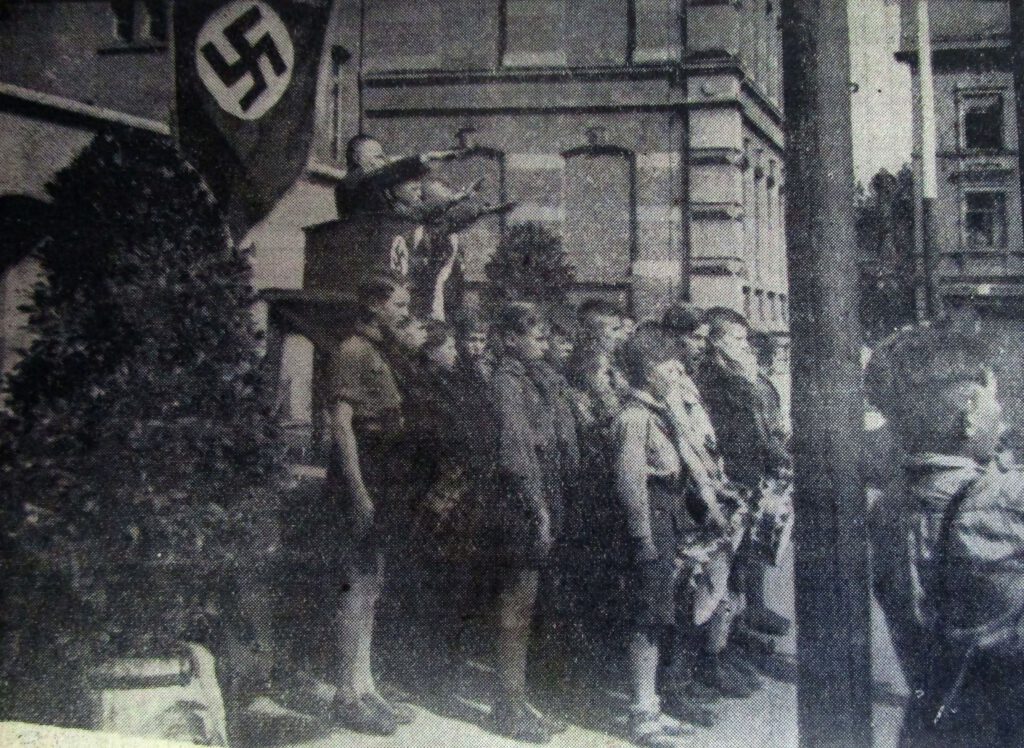
(Source: Göppingen City Archives)
The Protestant Girls’ School, which had previously been housed in two buildings under a single administration, and the Catholic Elementary School were also reorganized. Under the umbrella term “German School,” there were now three independent elementary schools: the aforementioned Hans-Schemm-Schule for boys (Principal’s Office I), the Schillerschule as an elementary school for girls (Principal’s Office II), and the Schlageter-Schule (Principal’s Office III), which shared its building with the girls’ secondary school – in what is now the Mörike-Gymnasium school building. It could not be determined with certainty whether the Schlageter-Schule was an elementary school for boys or for girls. It is possible that this school had classes separated by gender. The name “Schlageter” was intended to commemorate a “martyr” of the Nazi movement.
The primary victims of the school reform carried out under the swastika were Jewish children of elementary school age.
Doris Rosenkranz, born in 1927, recalled, for example, that after two years of attending school, she was forced to leave the state-run Protestant girls’ school in Göppingen – an experience that remained a traumatic memory for her throughout her life. Following this turning point, her mother decided to move to Stuttgart, where Doris was able to attend a public school until November 1938. Mother and daughter fled to Switzerland in 1939.
Herbert Steiner, also born in 1927, had attended the Evangelische Knabenschule (Protestant boys’ school), which he was forced to leave in June 1936. From the window of the Jewish school across the street, he watched his former classmates playing in the schoolyard. “It was strange – now they were the ‘others’…” he recalled later.
From the perspective of Jewish children and parents, however, there were certainly reasons even before May 1936 that made it seem advisable to protect the children from the ‘Volksgemeinschaft’ (national community). Hermann Freudenberger, a refugee from Göppingen, recalled in a letter from 1966: “I couldn’t bear to watch how my children were treated at school”. Of course, whether the Nazi younglings were kept in check depended heavily on the teacher’s decency, and a teacher like Karl Baun – who made it clear to his students at the Evangelischen Knabenschule that their Jewish classmate Erich Steiner, Herbert’s older brother, “belonged with us” – was certainly a positive exception. The former Social Democrat Karl Baun was a teacher and principal at the school until he was forcibly removed by the Nazis.
Other towns and municipalities in the Göppingen district yielded to the pressure to establish a “German School” at varying rates. A look at the 1937 address book shows that primarily larger municipalities and towns such as Eislingen, Ebersbach/Fils, and Reichenbach/Fils had a “German School,” but so did smaller communities such as Salach, Wangen, and Holzheim. In the majority of the smaller municipalities, however, denominational schools still existed at that time. The abolition of denominational schools was not supported by the entire population everywhere.
Carola Eberhard, the archivist in Süßen, describes the developments there: “From May through July 1936, the mayor pushed for the dissolution of the existing denominational schools. An application to convert the Protestant school was filed in July 1936; the Catholic school was closed in October (after many protests), and the students were transferred to the ‘Deutsche Schule’.” Surprisingly, the Jewish student Hugo Lang was allowed to attend the Süssen “German School” until November 1938 – that is, until he completed the 8th grade. His cousin Kurt Lang, who was a year younger and had attended the Hohenstaufen-Oberschule (High School) in Göppingen, was, however, denied admission to the “German School” in Süssen in October 1938.
The Founding of a Private Jewish School in Göppingen
To ensure the education of Jewish children, the board of the Göppingen Jewish Community decided, despite limited financial resources, to establish a school for Jewish children starting at the elementary school level. Many Jewish communities in what was then Württemberg faced this challenge. By the fall of 1937, 15 private Jewish schools had been established in the state, set up and financed by the Jewish communities, and operating under the authority of the High Council of the Jewish Religious Community of Württemberg in Stuttgart.
The ground floor of the rabbi’s house at Freihofstr. 46 was designated as a classroom. The space had become available after Cantor Levi moved out upon his retirement. Bertha Tänzer, the widow of Rabbi Dr. Aron Tänzer, continued to live on the upper floor of the house until December 1937, while his successor, Rabbi Luitpold Wallach, had found an apartment at 8 Rosenstrasse. The newly hired teacher and cantor, Fritz Max Erlanger, also lived off-site in rented accommodations.
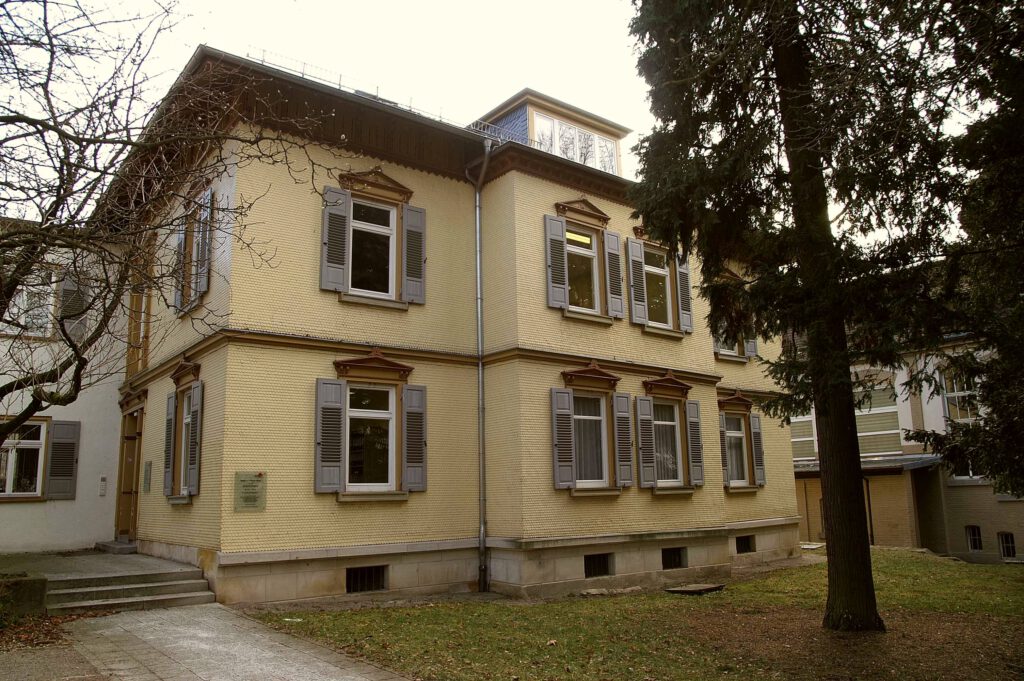
Among the active members of the Jewish community, it was Julius Guggenheim in particular who had contributed to the establishment of the Jewish school.
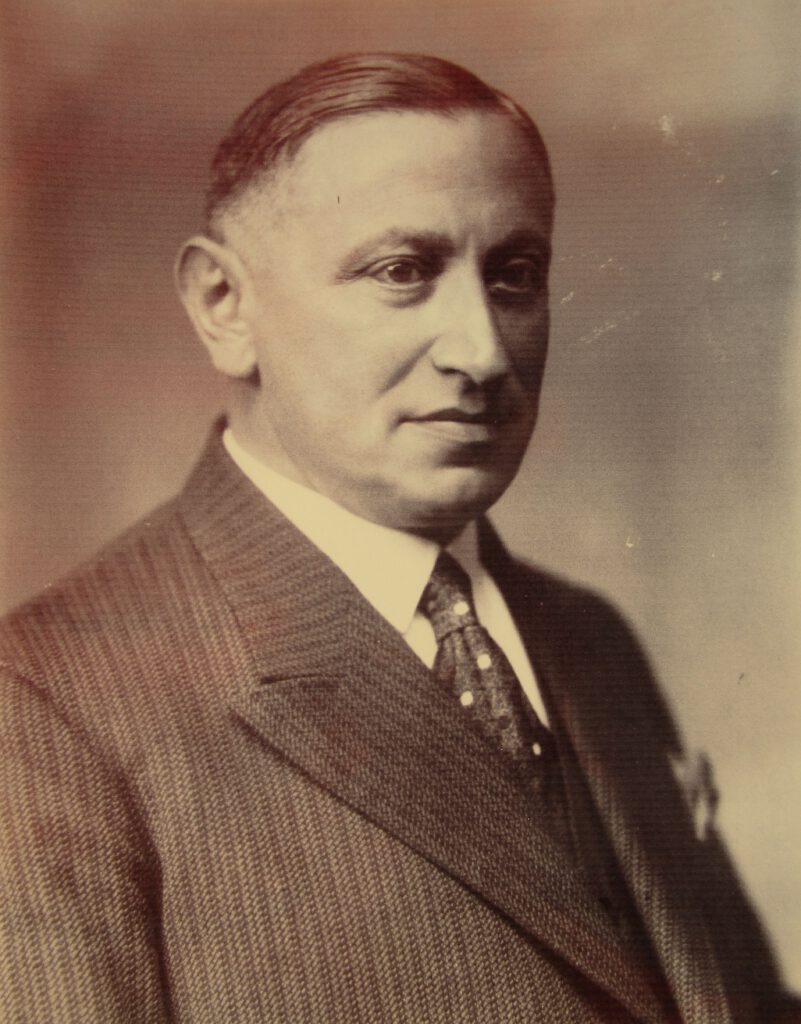
(Source: Initiative Stolpersteine Göppingen)
When he left Göppingen, where he had served on the community board for ten years, his fellow board members honored him (farewell letter dated May 12, 1937):
“Of all these achievements, the founding of the Jewish private school in Göppingen was the most significant and fundamental, and it was accompanied by the search for a suitable teacher who could also serve as cantor. With loving care and tireless dedication, you took on this task and, thanks to your relentless efforts, achieved the desired goal.”
The teacher and cantor mentioned in the thank-you letter is the aforementioned Fritz Max Erlanger.

photographed before May 1933 (Source: Geschichtswerkstatt Tübingen)
After him, Rabbi Dr. Luitpold Wallach taught; there is also mention of “assistants.” Photos from a school field trip show, in addition to the teacher Erlanger, other young adults who could not be identified.
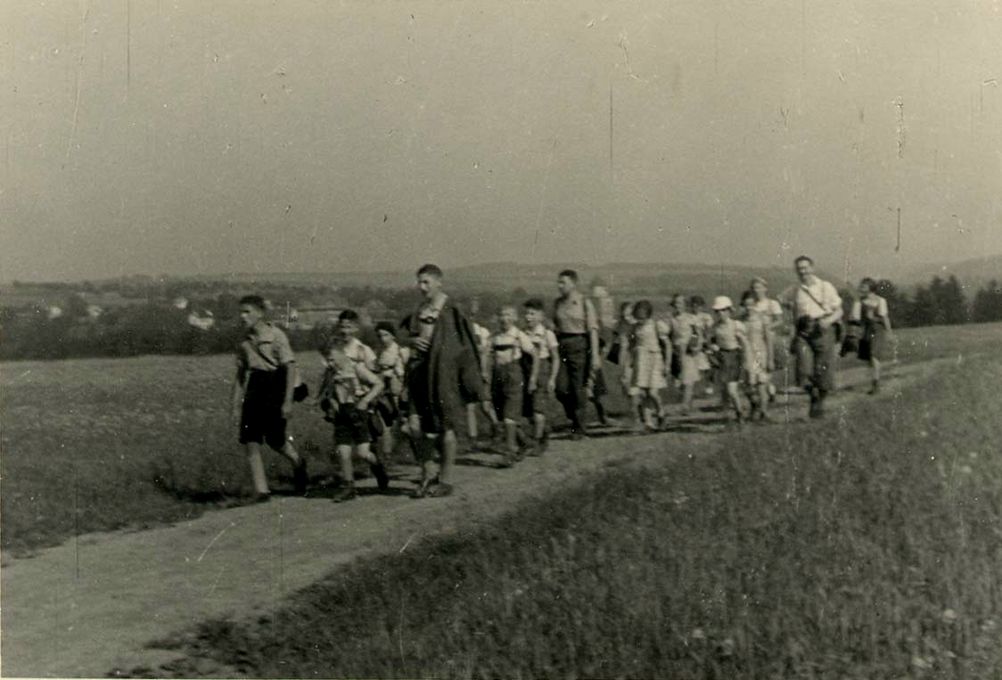
(Source: Initiative Stolpersteine Göppingen)
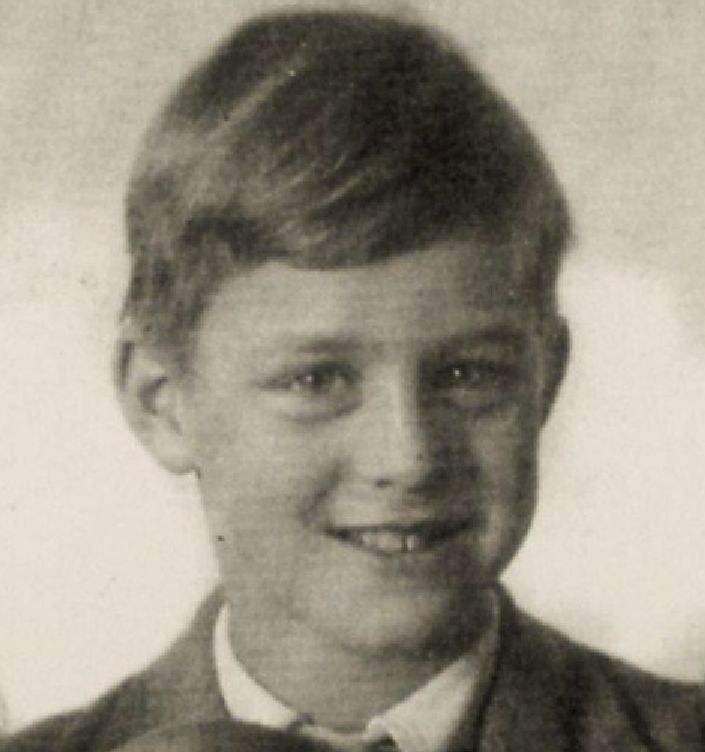
Not all Jewish parents in Göppingen wanted to entrust their children to the new school, where students from several grade levels were taught in a single classroom – much like a village school of the past. This might explain why Doris Rosenkranz moved to Stuttgart. The decision made by the parents of Richard Fleischer, born in 1927, could also be understood in this context.
(Source: Initiative Stolpersteine Göppingen)
He wrote: “My school was on Uhlandstraße (= Ev. Knabenschule). I left school – or rather, was expelled – in 1936. It was made clear to my father that I could not stay here under any circumstances. My father sent me to Esslingen.” (This refers to the Jewish orphanage and boarding school “Wilhelmspflege” in Esslingen – Author’s note.)
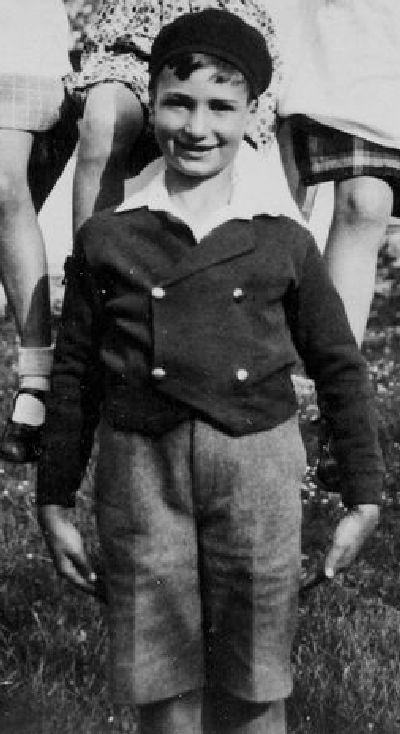
It is difficult to determine exactly how many students attended the Jewish School in Göppingen and who they were. Former student Herbert Steiner refers to the period from the school’s opening in September 1936 until his escape in December 1938: “If I remember correctly, we had about 20 to 30 children aged 6 to 14 in one room”.
(Source: Initiative Stolpersteine Göppingen)
His classmate Beate Dörzbacher (later Betty Greenberg), also born in 1927, kept a poetry album that she had received from her teacher Fritz-Max Erlanger as a farewell gift in July 1937. It contains the signatures of 17 of her classmates. This total of 18 schoolchildren corresponds in scale to the number of 17 students mentioned on page 66 of Paul Sauer’s book, *The Fates of the Jewish Citizens of Baden-Württemberg, 1933–1945″. Sauer refers to the Official Gazette of the Württemberg Ministry of Culture dated November 27, 1937.
Of the students attending the school on that date, two lived in Süßen (Ruth Lang and Siegfried Lang) and two in Eislingen (Pnina Plawner and Leo Lerner); the rest were from Göppingen. A class photo from Leo Lerner’s legacy shows 20 children and their teacher, Erlanger.
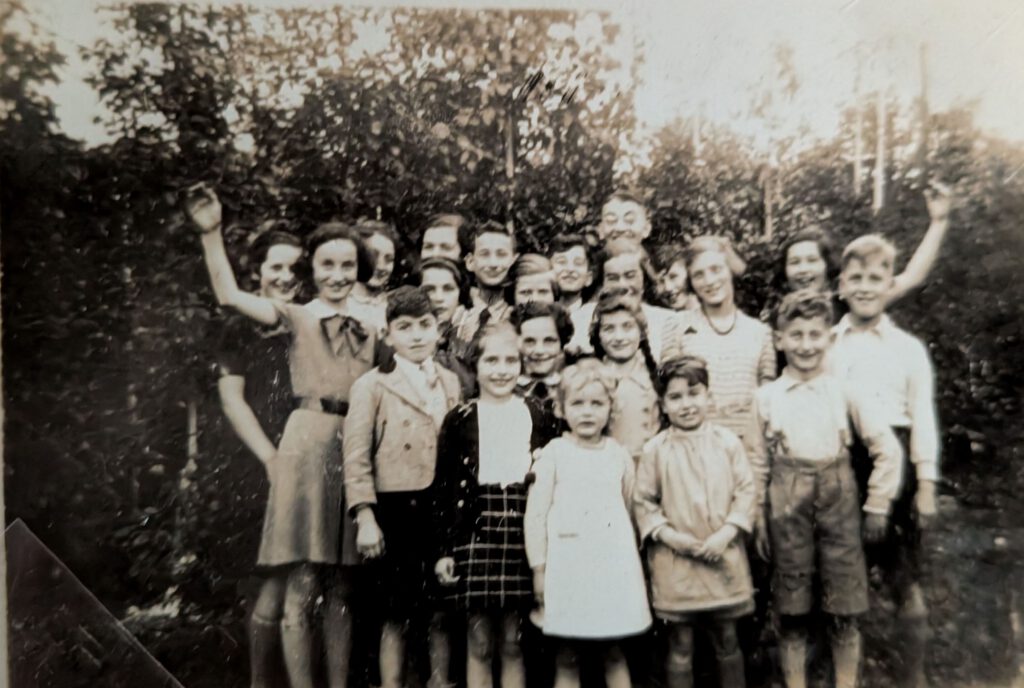
In the very front, wearing a white dress, is Rachel-Dina Plawner
(Source: Initiative Stolpersteine Göppingen)
Clearly visible in the foreground is the girl Rachel-Dina Plawner, the younger sister of the schoolgirl Pnina Plawner. Since the sisters were deported to Poland in late 1938 or early 1939, the photo must have been taken before then. Based on her clothing, the photo likely dates from the summer of 1938. Rachel-Dina Plawner was only four years old at that time and would not yet have been attending school. She may have been allowed to appear in the class photo as a “guest.” We therefore do not include her in the list of known students.
The fact that we know the names of 20 students suggests that, following the departure of at least six children since July 1937, a significant number of new students have enrolled. Unfortunately, only a few of these new students are known by name.
- Inge Banemann * 08.03.1930 in GP, deported 01.12.1941 to Riga, murdered
- Margot Bernheimer * 16.12.1924 in GP, fled to the USA on 15.07.1939
- Edith Block * 07.06.1928 in GP, fled to the USA on 05.07.1938
- Irene Block * 04.07.1930 in Stuttgart, fled to the USA on 10.07.1938
- Beate Dörzbacher * 20.11.1927 in GP, fled to the USA on 05.07.1937
- Günther Dörzbacher * 20.09.1928 in GP, fled to GB on 15.09.1939
- Ruth Dörzbacher * 21.11.1924 in GP, fled to GB on 15.09.1939
- Ruth Lang * 27.07.1925 in Süßen, deported 01.12.1941 to Riga, survived
- Siegfried Lang * 10.07.1925 in Süßen, deported 01.12.1941 to Riga, survived
- Leo Lerner * 03.09.1929 in GP, escaped to China on 30.05.1939
- Pnina Plawner * 07.03.1926 in Haifa, escaped to Poland in 1939, murdered
- Rita Puder (no data available)
- Doris Rödelsheimer * 18.08.1930 in GP, deported 01.12.1941 to Riga, murdered
- Lise Rödelsheimer * 31.08.1928 in GP, deported 01.12.1941 to Riga, murdered
- Kurt Rothschild * 04.03.1929 in Stuttgart, fled to the USA on 10.02.1938
- Ruth Rothschild * 19.03.1931 in Stuttgart, fled to the USA on 10.02.1938
- Herbert Steiner * 08.12.1927 in GP, fled to the USA on 26.11.1938
- Hilde Stern * 04.01.1929 in Gießen, deported 01.12.1941 to Riga, murdered
- Wolfgang Veit * 17.05.1927 in GP, fled to Belgium on 14.01.1938
- Ruth Vollweiler * 30.09.1927 in Kirchheim/Teck, fled to Argentine in 1940
During the pogrom night of November 9 – 10, 1938, the Nazis intended to destroy not only the synagogue but also the neighboring rabbi’s house and, with it, the school building. After the war, Max Eder (1881 – 1950) – the fire department equipment manager and caretaker of the fire station, a former Social Democrat who had been a member of the NSDAP since 1937 – claimed in an affidavit that he had prevented this from happening. He claimed to have successfully refused to hand over training incendiary devices from the fire department’s inventory to the SA arsonists.
After Pogrom Night, the Nazi administration had banned Jewish children from attending any public school, which led to new students enrolling at the Jewish School in Göppingen. For example, Margot Bernheimer had to transfer from the Göppingen ‘Mädchenrealschule’ (Girls’ Secondary School) to the Jewish School, and Ruth Vollweiler now traveled daily by bus from the town of Kirchheim/Teck, about 20 km away, to Göppingen. These new students confirm that classes were able to continue even after Pogrom Night.
It is unclear whether, and if so, for how long, the rabbi’s house continued to be used as a classroom after Pogrom Night. School operations there likely ceased by June 9, 1939, at the latest, as the city of Göppingen acquired the building on that date, and according to the address book, it remained unoccupied. It is unlikely that the Nazi city administration would have permitted Jewish children to attend classes in “their” building. However, since there are indications that classes continued into 1940, the Jewish school must have found another classroom. Rooms in the Hotel Dettelbacher, which had been rented by the Jewish community, are out of the question, as this building, too, had to be sold to the city of Göppingen, which had it demolished in July 1939.
It also remains unclear how long Fritz-Max Erlanger was able to work as a teacher at the school in Göppingen. His student Herbert Steiner recalled that after “Mr. Erlanger’s departure”, Rabbi Wallach took over the classes. The Steiner family fled Göppingen on November 28, 1938. On March 16, 1938, Fritz-Max Erlanger still held a parents’ evening. The (first?) change in teachers from Erlanger to Wallach can thus be narrowed down to the period between March 16 and November 9, 1938. This is because Mr. Wallach was interned at the Dachau concentration camp from December 12 to December 29, 1938, and classes likely ceased during his absence. Mr. Wallach may have resumed teaching until his escape on August 28, 1939. Mr. Erlanger was released from the concentration camp on December 5, 1938. However, he may have taken over the classes again, especially since Mr. Wallach was already planning his escape. If classes were indeed held at the school until 1940 (the family of student Ruth Vollweiler fled Nazi Germany in March 1940), then Fritz-Max Erlanger must in any case have been available again as a teacher. He did indeed live in Göppingen until mid-1941, but presumably had to perform forced labor after the school closed.
In December 1940, when the Jewish child Inge Auerbacher, at the age of six, was ready to start school, the Jewish school in Göppingen – regardless of its location – could no longer have existed. Inge had to take the train to Stuttgart to attend the only Jewish school in the entire region. The children from Göppingen and Süßen – Inge Banemann, Ruth and Siegfried Lang, Doris and Lise Rödelsheimer, and Hilde Berta Stern – had to forgo further schooling, even though they were still of school age. On June 30, 1942, the Nazi administration closed the last remaining Jewish schools in the state.
About the Jewish School’s Curriculum
What subjects were taught at the Jewish school, and what were the educational goals? Student Herbert Steiner recalled: “The subjects at the Jewish school were ‘normal,’ but of course, with only one teacher and about 30 students across all grades, the classes were a bit chaotic. When I arrived in America in 1939, I knew more about math than most of the children here, but English was foreign to me, and religious education didn’t play a major role.” Herbert Steiner, born in 1927, transferred from the neighboring Evangelischen Knabenschule to the Jewish school when he was in elementary school; in his opinion, the school “comes off quite well’.
Margot Bernheimer, who was three years older, likely had a different experience at school when, after November 14, 1938, she was forced to transfer “down” from the ‘Mädchenrealschule’ to the Jewish school. In a letter, she wrote: “Most of the Jewish children who could no longer attend school went to the very modest school that the community ran with one teacher and a few volunteers in the community center, which was still standing after the synagogue had been destroyed. I was one of them.”
What Teacher Erlanger hoped to achieve with his lessons becomes clear in an article in the ‘Israelitisches Wochenblatt’ dated March 16, 1938, which reports on a parents’ evening:
“He warned that the traditional professions offered no promising prospects for our youth anywhere in the world. Today, opportunities exist only for manual laborers – artisans and farmers – and even then only with thorough prior training. The speaker then highlighted the various training opportunities available today both at home and abroad, focusing in particular on Hascharah and Youth Aliyah.”
Terror and Murder
At the Jewish school, the children were protected from unjust teachers and hostile classmates. But the brutal reality caught up with them again outside of school and their parents’ homes. Herbert Steiner writes from painful experience: “The direct route to school from Bahnhofstraße 6 wasn’t very long, but the detours I had to take to avoid the stones thrown by the other schoolboys made it a serious undertaking.” The bus ride to Göppingen was also a source of fear for Leo Lerner, a child from Eislingen. On his way to the Eislingen bus stop, he was regularly taunted and attacked.
Of the 21 students at the Jewish School in Göppingen whose names are known to us, 14 were able to flee with their families; five children were murdered by the Nazis: Pnina Plawner, Lisa and Doris Rödelsheimer, Inge Banemann, and Hilde Stern. Their teacher, Fritz-Max Erlanger, who had moved to Ahlem in 1941, was deported from Hanover to Riga and died as a result of persecution in 1945.
(11.08.2026 kmr)

