Intended installation location: Göppingen, Poststraße 25
A Prussian in Göppingen
Dr. med. dent. Albert Salinger had been living in Göppingen since around 1902. He was born in 1877 in what was then West Prussia; at the time of his birth, his hometown of Deutsch Krone (today: Wałcz, Poland) had a population of about 63,000, including some 2,000 Jewish residents, a community to which Albert Salinger also belonged. His father, David, a merchant by profession, was married to Minna, née Nathusius. Albert had at least one older brother named Hermann. From the winter semester of 1896–97 through the winter semester of 1898–99, Albert studied dentistry at Friedrich Wilhelm University in Berlin. Prior to that, he had spent a semester at the University of Greifswald. His educational path was typical for a gifted child from a Jewish merchant family: at least one of the children was expected to pursue an academic career.
It is not known where Albert completed his studies, nor what prompted him to move to Göppingen, where he presumably began his practice. However, he could be certain that he would be needed as a dentist there, since in 1902 there were only two other dentists practicing in the city besides him. His first address was Obere Marktstraße 36, where he rented an apartment.
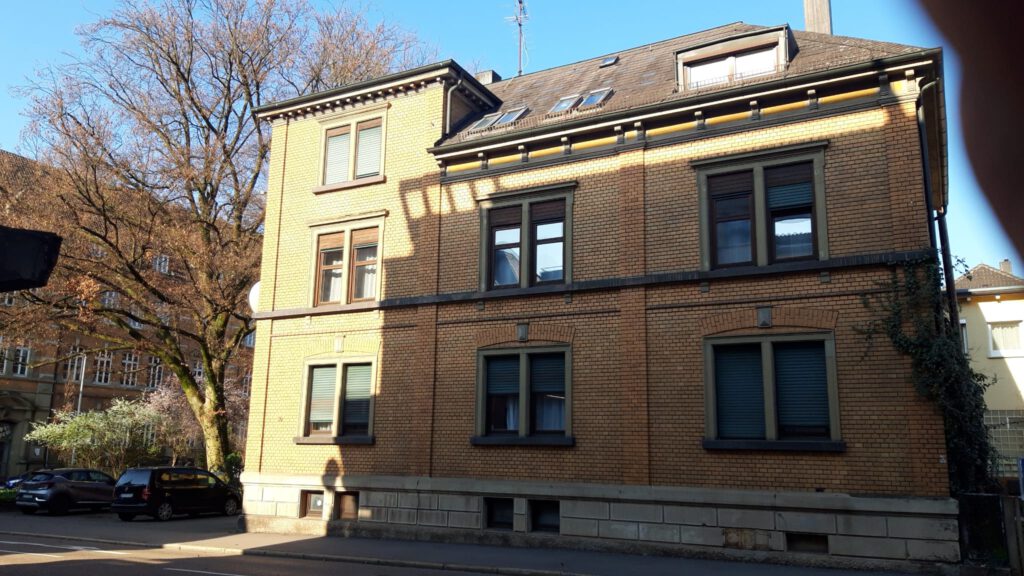
(Source: Initiative Stolpersteine Göppingen)
Located northeast of the old town center, the house – built in 1895 – stood on the edge of Göppingen’s first residential neighborhood. A document from 1903 indicates that Dr. Salinger was also permitted to treat patients covered by public health insurance.
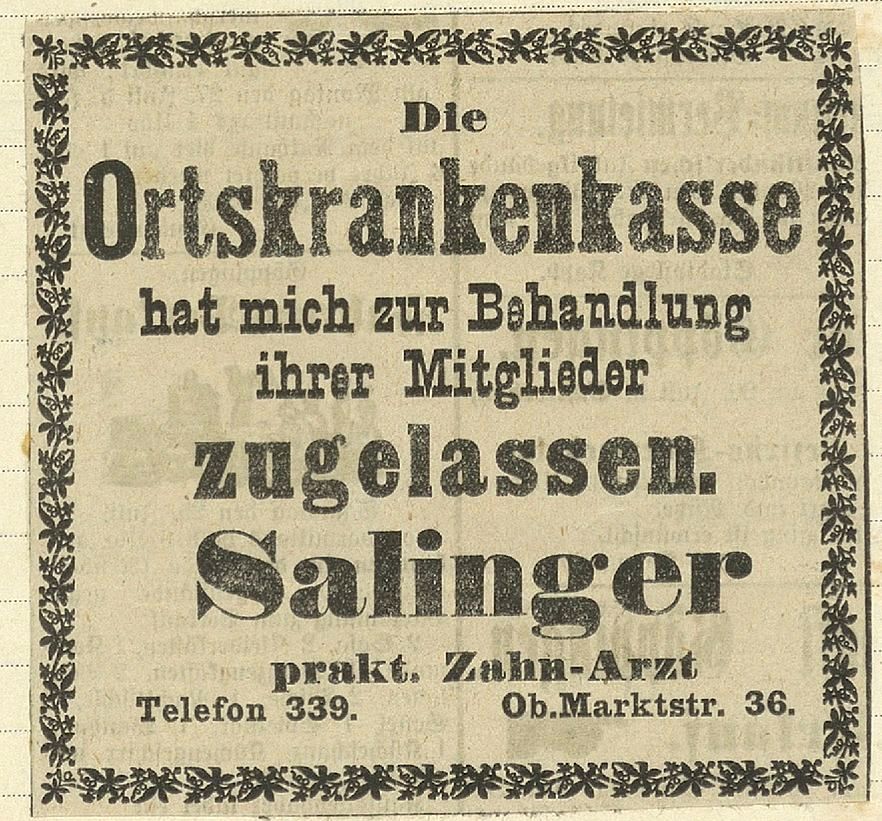
(Source: Ludwigsburg State Archives)
Over the next 10 years, Dr. Salinger lived a quiet (reclusive?) life in Göppingen; he was not active in the Jewish community. Perhaps it was no coincidence that he did not find a partner there, for on December 27, 1913, he married Milda Rosenthal, who had been born in Annaberg, Saxony, in 1890. The wedding took place in 1913 in Dresden, the capital of Saxony.
Milda Rosenthal
Milda was the third of five sisters, the children of Flora/Fromet (née Schiller) and Hermann/Chaim Rosenthal. In the Saxon mining town of Annaberg (today: Annaberg-Buchholz), located in the Ore Mountains, her parents were among the founders of the (liberal) Jewish community, which in 1890 numbered just 78 people. Hermann Rosenthal, born in Samter, Province of Posen (today: Szamotuły, Poland), had settled in Annaberg in 1884 and initially opened a clothing store on Buchholzerstraße, which was later relocated to Wolkensteinerstraße.
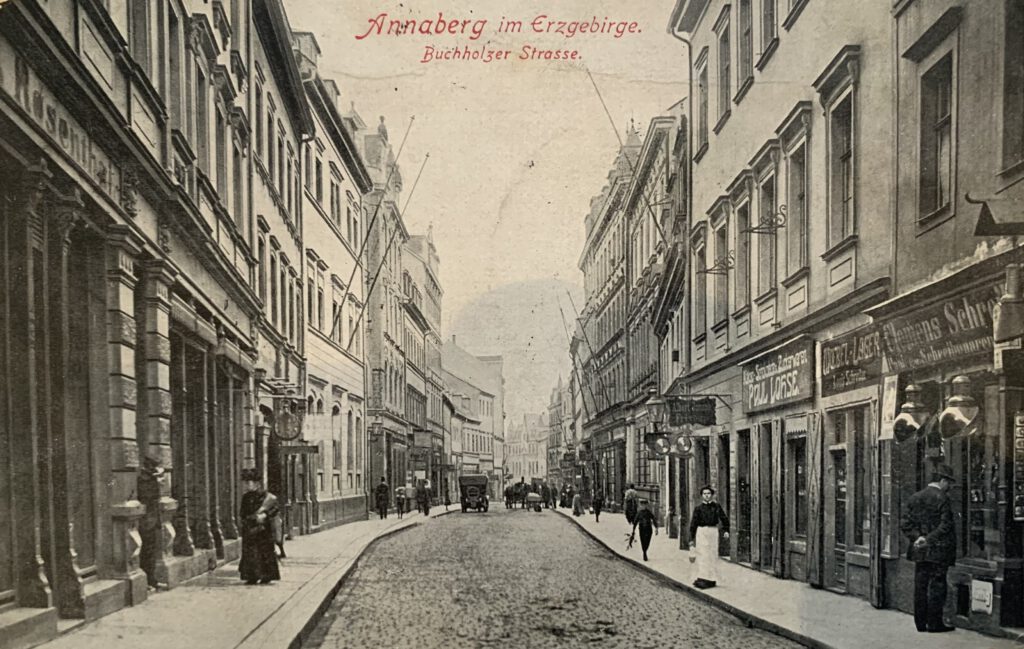
(Source: Collection of Dr. Bettina Levin)
Milda’s parents moved on to Breslau and eventually to Berlin, where, among others, Milda’s oldest sister, Rosa Alma Jakobsohn, lived. It is not known whether Milda received any formal education during her youth.
A New Address and Military Service
Milda and Albert found an apartment and practice together at Poststraße 25 in Göppingen, an impressive building owned by the nearby Schiettinger cardboard factory. Kuno Fleischer, co-owner of the prominent paper mill in Eislingen, was a neighbor of the Salingers, which confirms that it was a “prestigious” address.
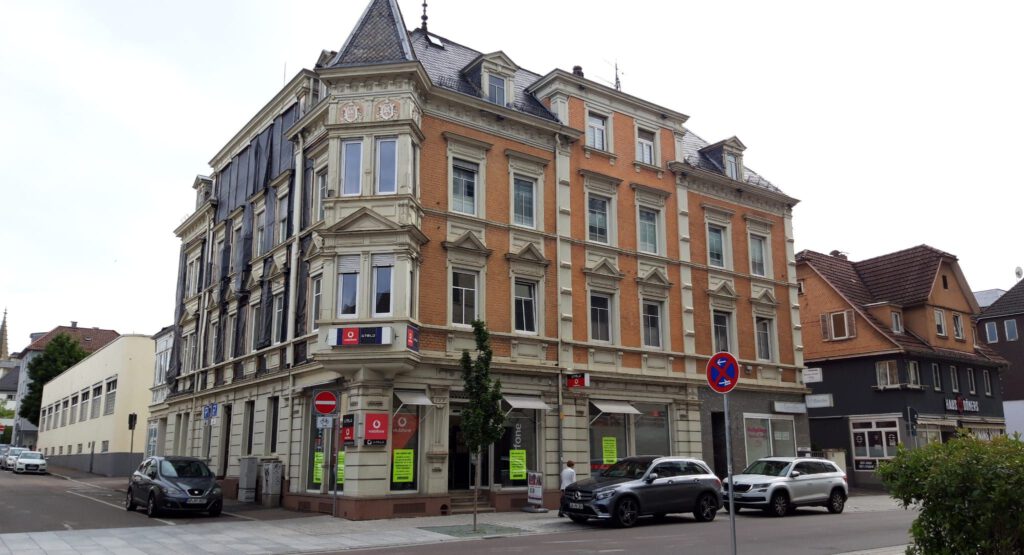
(Source: Initiative Stolpersteine Göppingen)
Like his neighbor Kuno Fleischer, Albert Salinger was also a member of the Göppingen chapter of the “German and Austrian Alpine Club.” He was an active hiker there for a time, as evidenced by his hiking reports from 1903–04.
Contrary to expectations, the Salingers initially remained childless. Instead, World War I also disrupted the lives of Milda and Albert. Albert Salinger had completed a “one-year” voluntary military training program in 1895–96, and in the three years that followed, he was called up for drills. Starting in 1916, he served as a “field dentist”; between 1916 and 1918, he likely served in field hospitals near the front lines, as he was wounded in August 1918 and subsequently awarded the Württemberg War Order, the “Charlottenkreuz”. In the postwar years, Albert Salinger was active in the Göppingen chapter of the “Reichsbund jüdischer Frontsoldaten” (Reich Association of Jewish Front-Line Soldiers), where he served on the executive board from 1923 to 1925 and was elected treasurer in 1936 – the only Jewish organization to which he belonged. The Göppingen chapter had been founded in November 1921 and had 30 members. The association’s primary goal was to counter the false claim that Jewish Germans had shirked their duty to serve in the war.
Elfriede and Heinz Martin
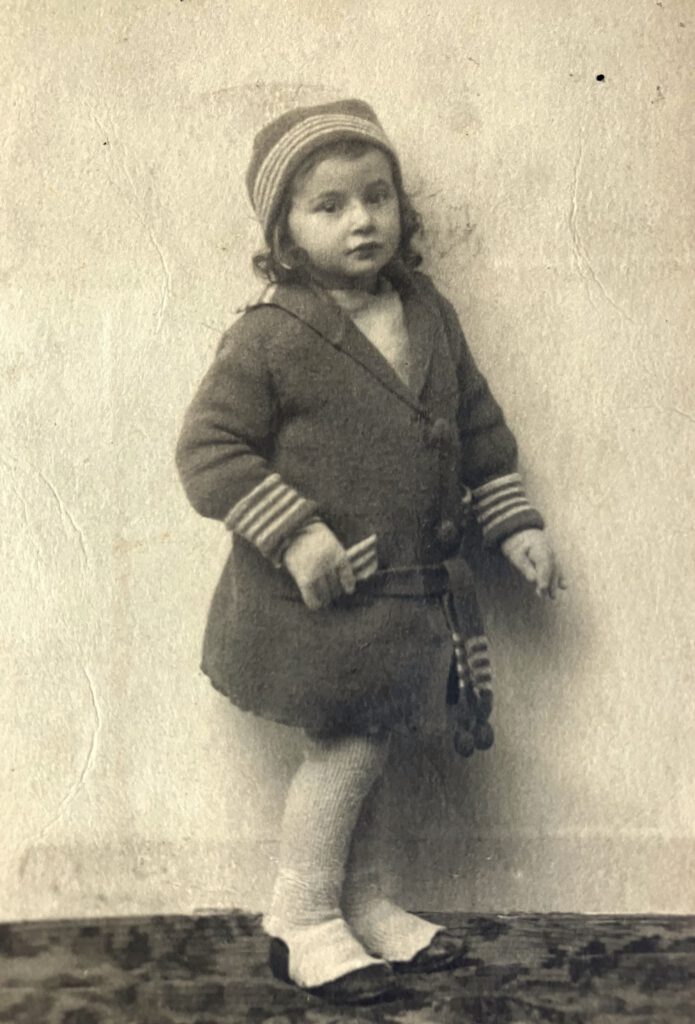
Elfriede Salinger was born in Göppingen during the final year of the war – more precisely, on February 24, 1918 –
(Quelle: Initiative Stolpersteine Göppingen)
and three years later, on March 3, 1921, Heinz Martin Salinger was born.
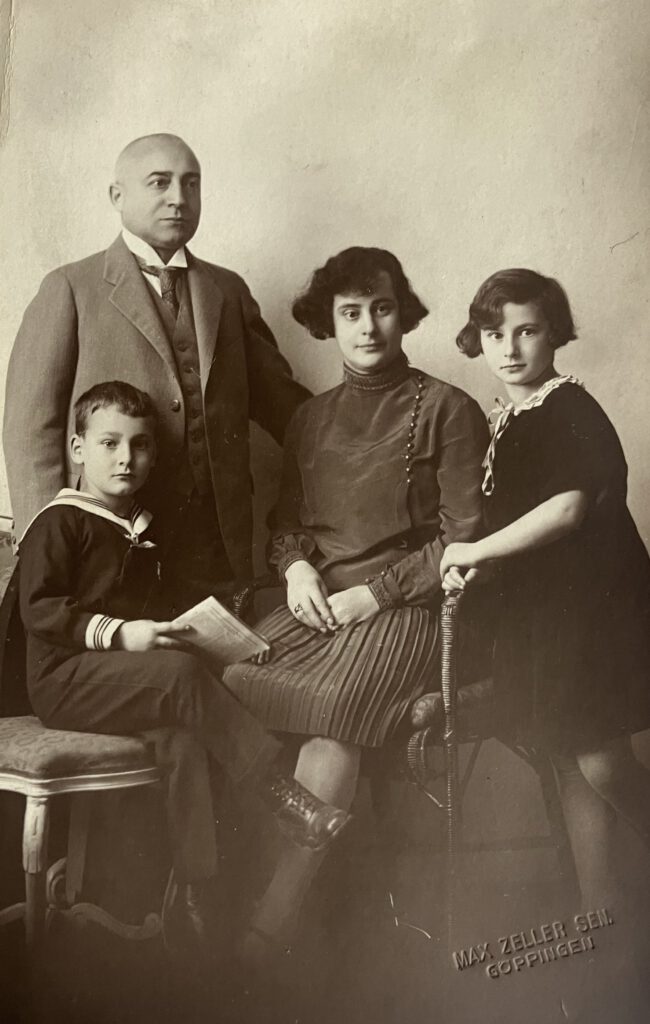
Heinz and Elfriede, ca. 1929 (Source: private collection)
Elfriede and Heinz found playmates in the neighbor’s children from the Tausch family, a Christian family that ran a specialty store for household goods at Poststr. 45.
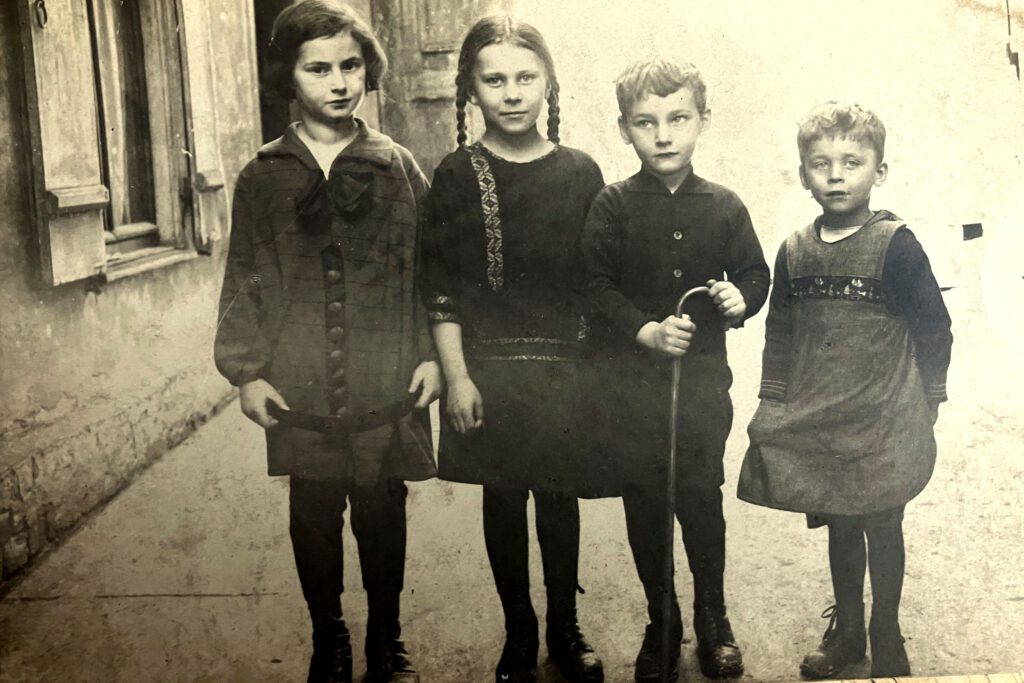
Elfriede Salinger, Lieselotte Tausch, Heinz Salinger, and Werner Tausch (from left)
(Source: Initiative Stolpersteine Göppingen)
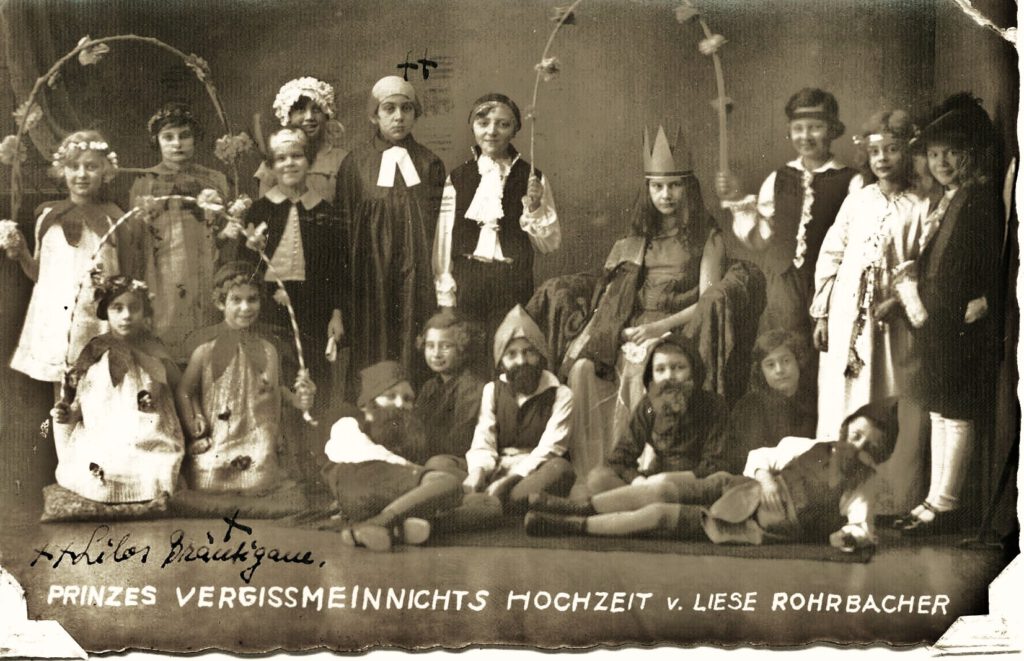
However, a document from 1929 confirms that there was also a connection to the children of the Jewish community. At the Hanukkah celebration at the Hotel Dettelbacher, Elfriede played the role of “Queen Rose” in a children’s play titled “Princess Forget-Me-Not’s Wedding”.
(Source: Göppingen City Archives)
It wasn’t just their daughter Elfriede who was interested in role-playing: there is also a photo of the Salingers dressed up in playful costumes.
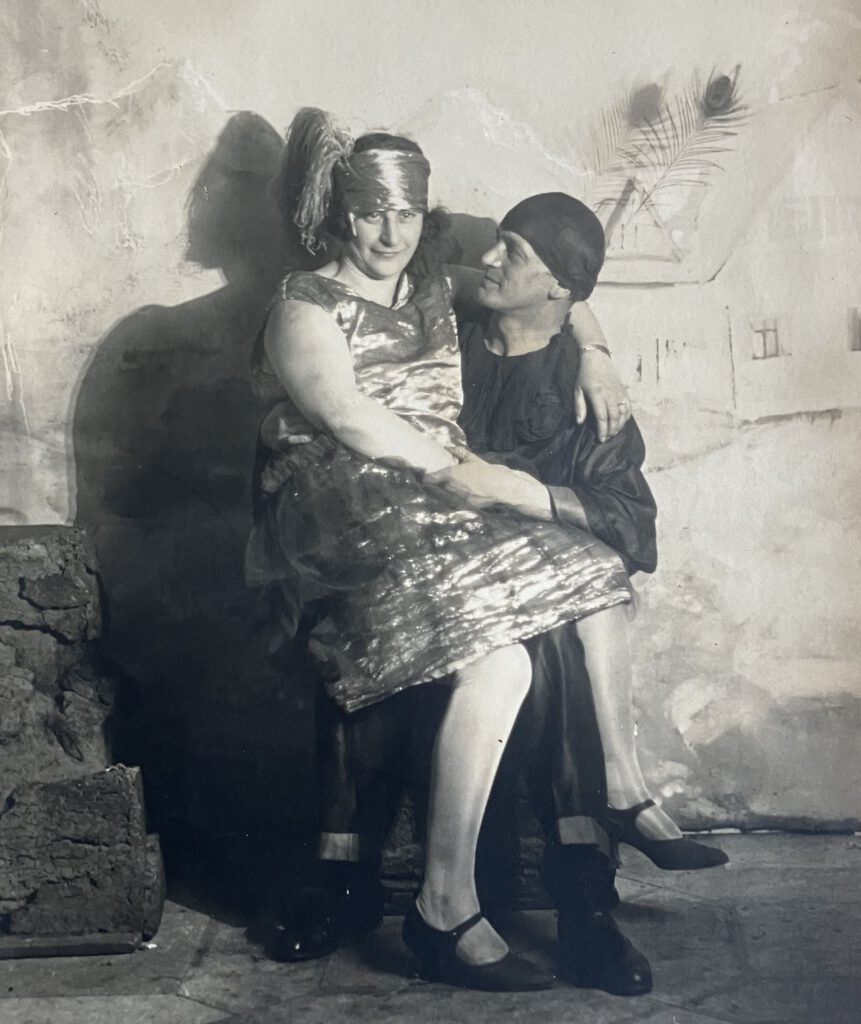
(Source: Initiative Stolpersteine Göppingen)
The two photos, taken on “Maientag” (May Day) in 1928, also suggest a carefree childhood (“Maientag” is Göppingen’s annual city, peace, and children’s festival).
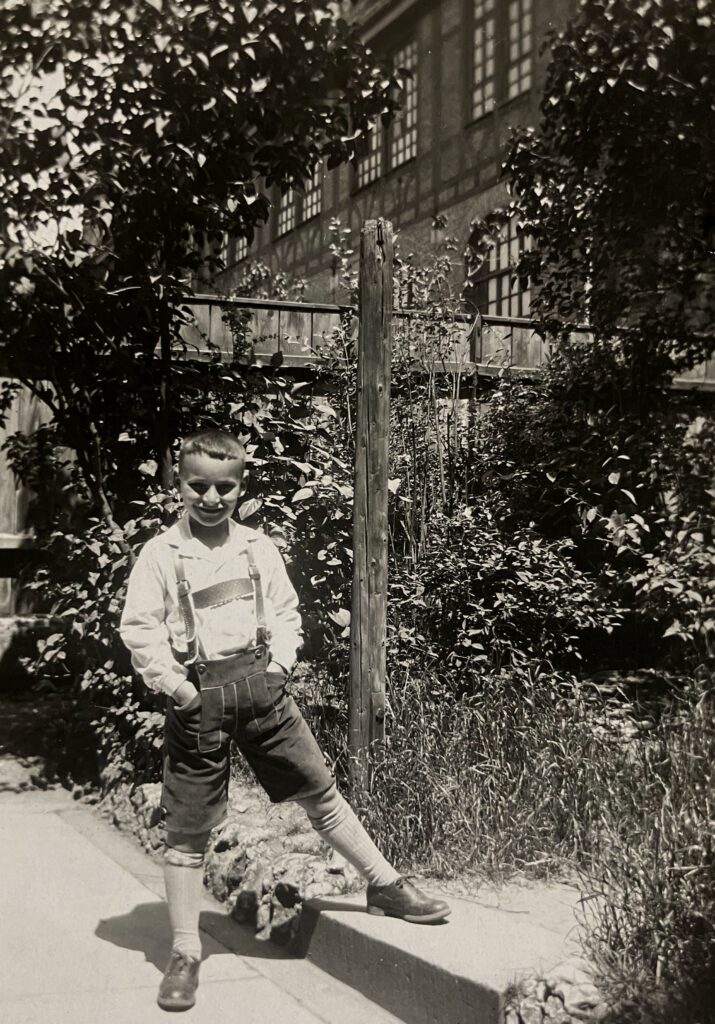
(Source: Initiative Stolpersteine Göppingen)
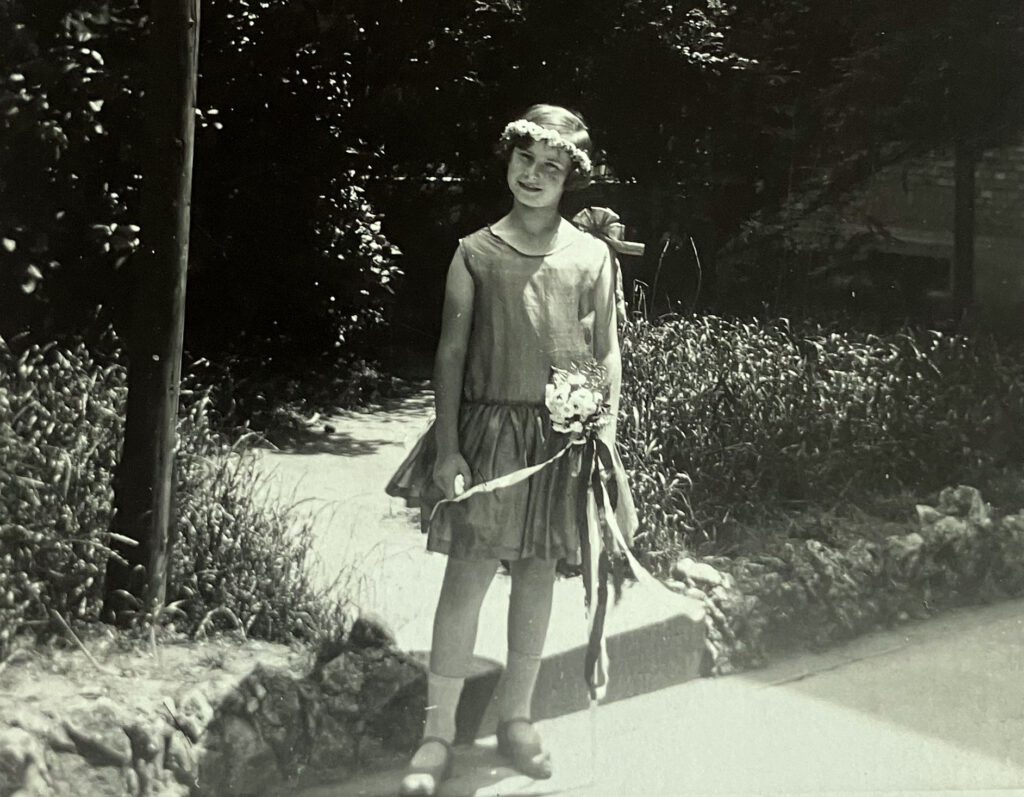
(Source: Initiative Stolpersteine Göppingen)
Heinz Martin Salinger, just 11 years old, died on September 11, 1932. His grave is located in the Göppingen Cemetery, in the Jewish section – Heinz’s death was certainly a terrible tragedy for his parents and his sister!
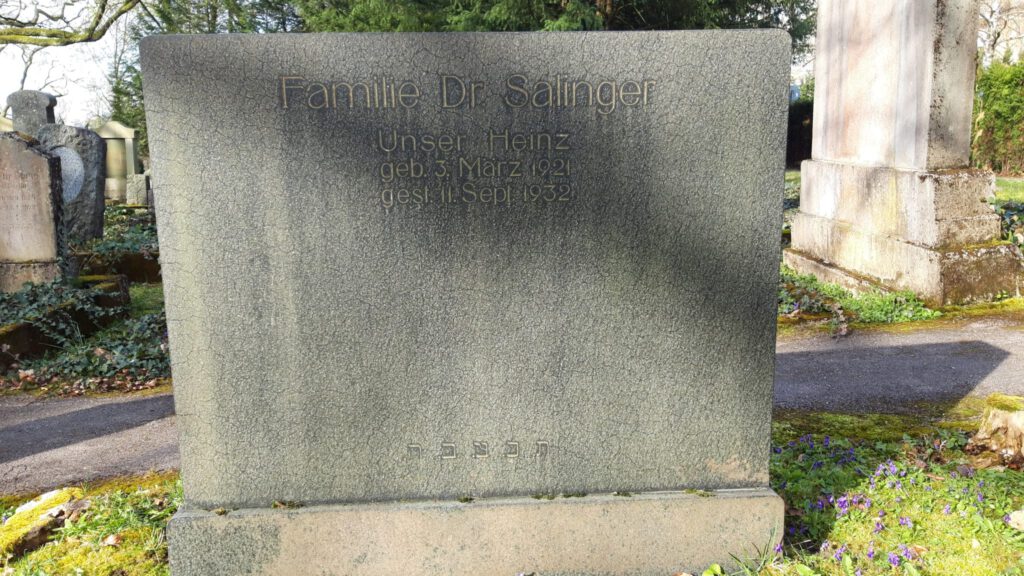
As the inscription on the headstone suggests, the plot was intended to serve as a family grave. In 1932, it apparently still seemed unthinkable to the family that they would be expelled from Germany.
Elfriede attended the Higher Commercial School in Göppingen; it is not known whether she was able to graduate. As her daughter recalls, she would have liked to become a doctor, but she would have been barred from pursuing a college degree during the Nazi era.
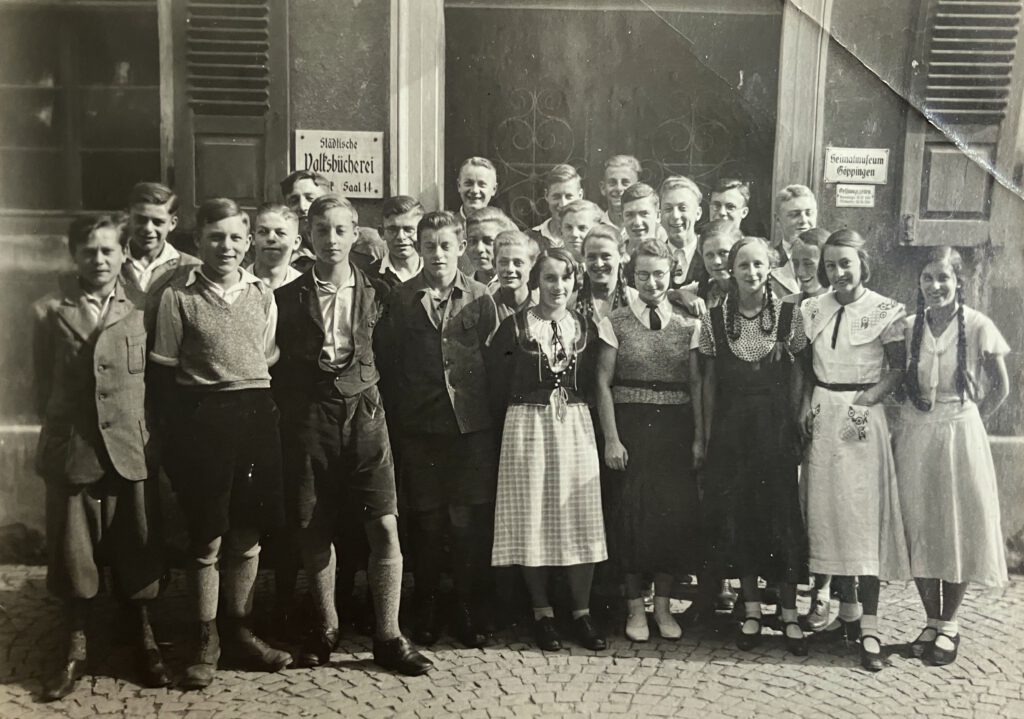
Elfriede, fourth from the right, in the front row
(Quelle: Initiative Stolpersteine Göppingen)
The Göppingen family also included – though it is not documented when she joined them – Milda Salinger’s mother, Flora Fromet Rosenthal (née Schiller), who had been a widow since 1928. She had presumably moved from Berlin to Göppingen after her husband’s death and returned to Berlin at the end of June 1936. It is very likely that she lived in the Salingers’ apartment. Milda’s sister, Alma Rosa Jakobsohn (née Rosenthal) – who was actually married in Berlin – also lived in Göppingen for a time. The only recorded date is that of her move from Göppingen to Berlin on August 29, 1938.
The Salinger Family During the Nazi Era
In Göppingen
Elfriede’s graduation that year thus took place during the Nazi dictatorship, and she must have had difficulty finding work. Only a few non-Jewish employers were still willing to hire Jewish employees. Elfriede’s stay in Heilbronn in 1938 remains a mystery. Apparently, she lived for a short time at the home of the Kahn family of businesspeople at Badstr. 10. Was she employed as a nanny for the two-year-old Valerie Kahn? In Heilbronn, she met a man named “Julian,” who gave her the book Hirtennovelle by Ernst Wiechert as a gift for her 20th birthday.
Since Elfriede moved to Berlin with her parents at the end of August, her stay in Heilbronn must have been brief. However, she may have remained with the Kahn family until they fled in January 1939 and only then followed her parents to Berlin.
Back in Göppingen: Albert Salinger was still allowed to practice his profession, but the pressure from the boycott on his non-Jewish patients likely led to a decline in his income. That may have been the reason he moved his home and practice between 1935 and 1937 to the house at Bahnhofstraße 6, which at the time still belonged to the Jewish Gutmann family.
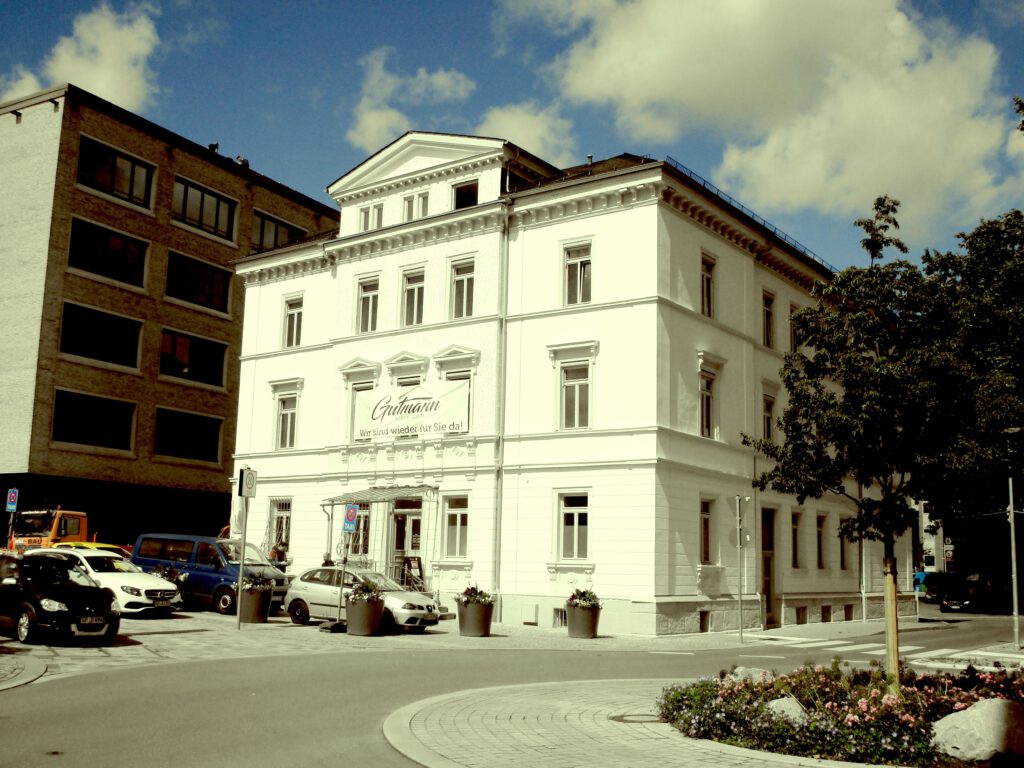
(Source: Initiative Stolpersteine Göppingen)
Albert Salinger presumably used smaller offices there than before and paid correspondingly less rent. The dentist Lothar Bauer, then a member of the NSDAP, moved into the former practice offices on Poststraße. However, there is no evidence of forced eviction. It is likely that Albert Salinger had employed a receptionist in earlier years. During his final years in Göppingen, he was assisted by Margarete (“Gretl”) Rosenfeld, who was about 16 years old at the time; she came from a Jewish family in Stuttgart and, after fleeing to the United States, married Leopold Guggenheim, a native of Göppingen. The fact that Gretl had to take the train from Stuttgart to Göppingen every day serves as an indication of how difficult it had become for Jewish Germans to find suitable work at that time.
On September 29, 1938, the Salinger family left the city where Albert had lived for 36 years and moved to Berlin-Charlottenburg. Milda’s sister, Alma Rosa Jakobsohn, who had lived in Göppingen for some time, moved with them.
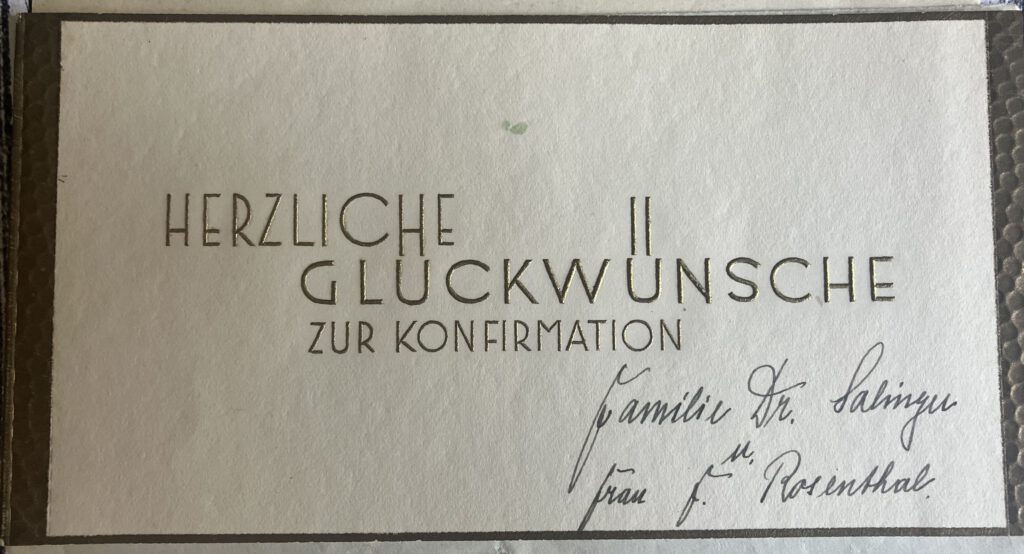
the signature “Flora Rosenthal” suggests
that Milda’s mother was staying in Göppingen
(Source: Initiative Stolpersteine Göppingen)
For years, however, Göppingen had ceased to be a town where Jewish citizens could feel at home. Neighbors, such as Gustav Tausch – whose children, Lieselotte and Werner, were friends with the Salinger children – had joined the anti-Semitic Nazis, despite their own experiences. As acting head of the district film office, he held a significant position within the local Nazis’ propaganda apparatus. His wife, Elsa (née Zendel), behaved differently; she did not belong to any Nazi organization, and neither did his son-in-law, Gerhard Bailer, who can be classified as an opponent of the Nazis.
In Berlin
Moving to distant Berlin was a natural choice for the Salinger family, since many relatives lived there, not least Milda Salinger’s elderly, widowed mother, Flora Rosenthal. In any case, Milda’s aunt Selma Cäcilie Fränkel, her uncle Siegmund Schiller, her cousins Herta Cohn and Elsbeth Prinz, and her cousin Erich Fränkel all lived in Berlin. On Albert’s side of the family, they at least encountered his brother Hermann Salinger in Berlin. Milda, Albert, and Elfriede – including Milda’s mother – found an apartment on Lietzenburgerstraße in Berlin-Charlottenburg, and Albert Salinger was presumably able to resume practicing as a general dentist for a short time.
In January 1939, Jewish dentists in Germany had their licenses revoked; a few were subsequently permitted to continue working as “dental practitioners for Jewish patients with dental problems” – Dr. Albert Salinger was among them.
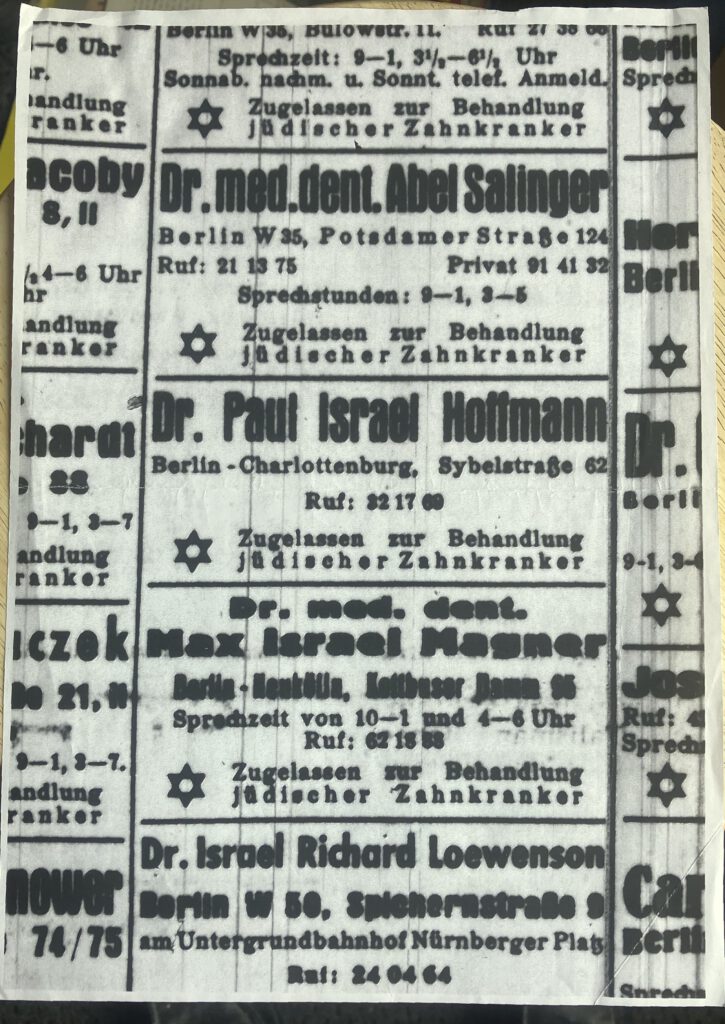
(Source: Initiative Stolpersteine Göppingen)
After the Pogrom Night of November 9–10, 1938, Albert Salinger does not appear to have been sent to a concentration camp. Whether he was arrested and released from a local prison after a short time remains unclear. There is no record of how the family’s economic situation developed, nor is it known whether Milda and their daughter Elfriede were able or required to contribute to the family’s income.
While Albert Salinger apparently still believed that the Nazi state could not do without Jewish German men in the event of war, his wife was making preparations for their daughter Elfriede to flee Germany.
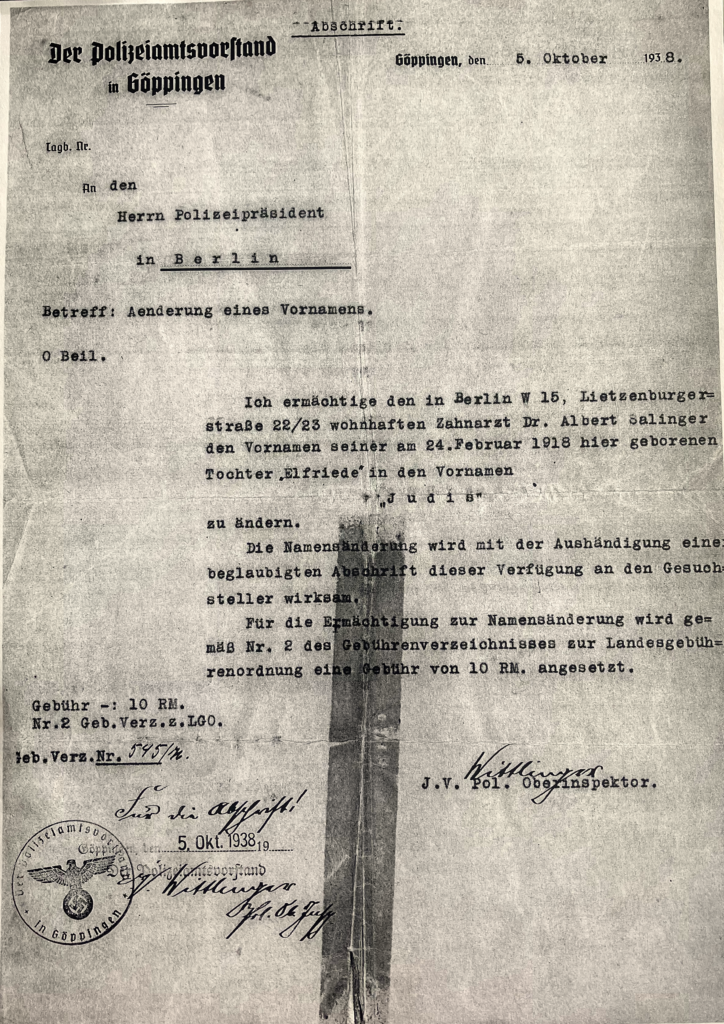
First, however, effective January 1, 1939, the Salingers were forced to change their first names to conform to Nazi requirements, the aim of which was to marginalize all Jews as “foreigners.” Jewish Germans usually complied with this coercion by adding the imposed names “Sarah” and “Israel” to their existing first names. However, the Nazis also offered the option of discarding their original first names and adopting a “Jewish” one, the choice of which was arbitrarily dictated. A so-called “choice” that was a caricature of self-determination? This is what Albert and Elfriede “chose”: They now called themselves “Abel” and “Judis,” while Mrs. Salinger used the additional name “Sarah.” Regarding the arbitrariness of the Nazis mentioned earlier: Even the name “Judith,” which is of Hebrew origin, was forbidden to Jewish Germans – hence the unusual variant “Judis.”
(Source: Initiative Stolpersteine Göppingen)
Elfriede Salinger’s Escape to Great Britain
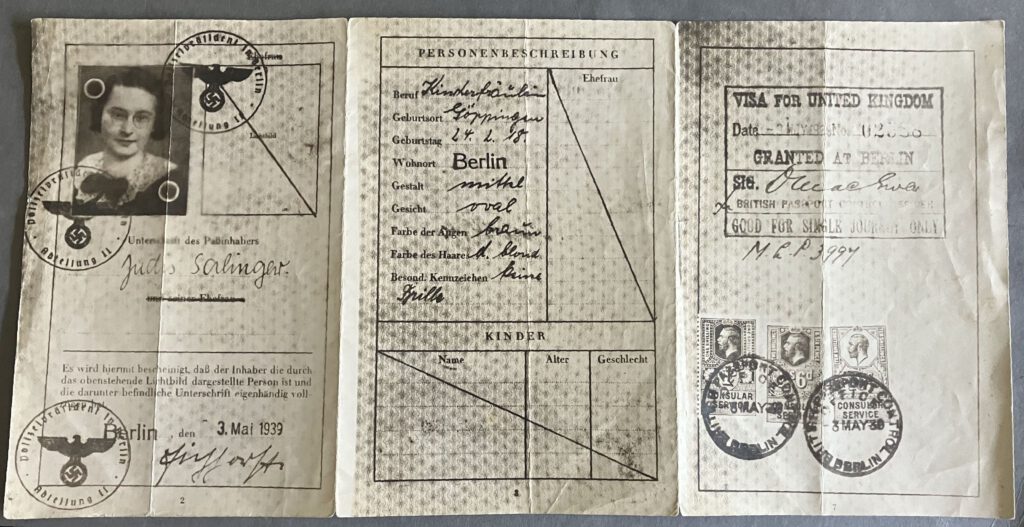
Elfriede “Judis” Salinger turned 21 in 1939, which meant she was no longer eligible for the “Kindertransport” of Jewish children to England. However, her mother, Milda, must have managed to find a family in Great Britain who was willing to take Elfriede in and employ her. As a result, Elfriede was able to leave for Great Britain in early May 1939.
David Horsley, Elfriede’s son, writes: “The little I know is that an arrangement had been made with a family in Sevenoaks, Kent, for her to stay there, help out around the house, and look after the children. My mother told me that she left Berlin to travel through Belgium or the Netherlands to catch a ship to Great Britain. On the train, she was harassed by German officials but was protected by some English passengers.”
(Source: Initiative Stolpersteine Göppingen)
IIn Great Britain, Elfriede no longer used her real first name – which was uncommon there – but instead called herself Judith, or “Judy” for short. However, Judy Salinger also faced the threat of Nazi Germany even in her place of refuge. As David Horsley notes: “Like most Londoners, she experienced the air raids in southwest London during the war.”
Later, Judy met and fell in love with James “Jim” Horsley, an Englishman two years her senior. The two were married in September 1941. The fact that James was a Christian and Judy was Jewish did not matter. As already suggested, the Salinger family likely had little connection to religion anyway. The marriage, which took place during the oppressive war years, began with a tragic event: in 1942, Judy gave birth to twins – one was stillborn, and the other died shortly after birth. Their daughter, Pauline Horsley, was born in 1943, and their son, David, in 1945.
Regarding his mother’s outlook on life, David Horsley writes: “She was someone who was always active and tried new things. She loved speaking her native language, German, and I remember that she enjoyed chatting with young German tourists. She was obviously cautious around older people.”
Albert and Milda Salinger: Death and Deportation
After her escape, Elfriede Salinger remained in contact with her parents via Red Cross telegrams. That is how she learned that her father, Albert Salinger, had died in Berlin on December 8, 1941. Albert Salinger was buried at the Jewish Cemetery in Berlin-Weißensee. According to the death certificate, Albert Salinger had died of arteriosclerosis. She also knew of the death of her 87-year-old grandmother, Flora Rosenthal, who had died in Berlin on January 23, 1943. Flora, too, was laid to rest in Berlin; she was buried in the grave of her husband, Hermann Rosenthal, who had died in 1918.
It was not until after the war that Elfriede/Judy Salinger learned of her mother’s fate: Milda Salinger, who had lost her own mother just a few days earlier, was deported from Berlin on February 3, 1943, on “Eastern Transport No. 28,” along with 951 other people, to the Auschwitz-Birkenau extermination camp, where she was murdered by the Nazi Germans.
More Storylines from the Families
In the Salinger family
Since Albert Salinger’s family background could only be pieced together in fragments, all that is known so far is that Albert’s older brother Hermann Salinger – who also lived in Berlin – was deported to the Treblinka extermination camp on September 19, 1942, and murdered there. Hermann had been married to Johanna, née Fehling, who was not Jewish. With her death in 1936, he had lost the protection afforded by a “privileged mixed marriage”.
The Rosenthal, Schiller, and Nathusius families, who suffered horribly at the hands of the murderous robbers
Milda’s older sister, Rosa Alma Jacobsohn (née Rosenthal), who also lived in Berlin-Charlottenburg, had been widowed just a few weeks before Milda. Her sons, Benno and Hans, were able to flee to the United States. Rosa was deported to the Piaski ghetto on March 28, 1942, and was subsequently murdered.
Margarete Panofski, née Rosenthal, another of Milda Salinger’s sisters, had already died in 1918. Her widower, Max Pankowski, managed to escape to Shanghai, China, during the Nazi era, while their daughters Betty and Ilse fled to Sweden.
Milda’s cousin Hertha Cohn, née Nathusius, lived in Berlin-Friedrichshain. She and her husband, Hermann Cohn, were deported to the Riga ghetto on January 25, 1942, and murdered there. Their daughter, Lydia Cohn, was deported to the Auschwitz extermination camp on November 1, 1942; Lydia’s sister, Gerda Cohn, suffered the same fate on February 26, 1943. Their son, Isbert Cohn, was also murdered at the Auschwitz extermination camp on November 29, 1942.
Milda’s cousin Elsbeth Prinz, née Nathusius, who lived as a widow in Berlin-Friedrichshain, was deported on October 3, 1942, to the Theresienstadt Ghetto concentration camp, where she died on April 17, 1944, as a result of the murderous living conditions. Her daughter, Rita Prinz, was initially deported on September 24, 1942, to the Raasiku camp near Tallinn, Estonia; on August 23, 1944, she was sent to the Stutthof concentration camp near Danzig, where she was murdered on December 27. Stolpersteine for both of them are located at Niederbarnimstr. 7 in Berlin.
Milda’s aunt, Selma Cäcilie Fränkel, née Schiller, lived as a widow in Berlin-Kreuzberg. On September 10, 1942, she was taken to the Theresienstadt ghetto concentration camp and murdered on September 29 of the same year at the Treblinka extermination camp. Her son, Erich Fränkel (also a cousin of Milda’s), was deported from Berlin to the Auschwitz extermination camp on March 12, 1943, and murdered there.
Milda’s uncle, Siegmund Schiller, who lived alone in Berlin-Kreuzberg, was taken to the Riga ghetto on January 19, 1942, where the 74-year-old was murdered three days later.
After the World War
Judith and James Horsley continued to live in the Greater London area. James worked for many years as a military musician and later as a bank messenger, while Judith, in addition to running the household and raising the children, worked as a saleswoman, a housekeeper, and, most recently, as a cashier at a small factory. Judith and James Horsley were blessed with four grandchildren; three were from their daughter Pauline, and one from their son David.
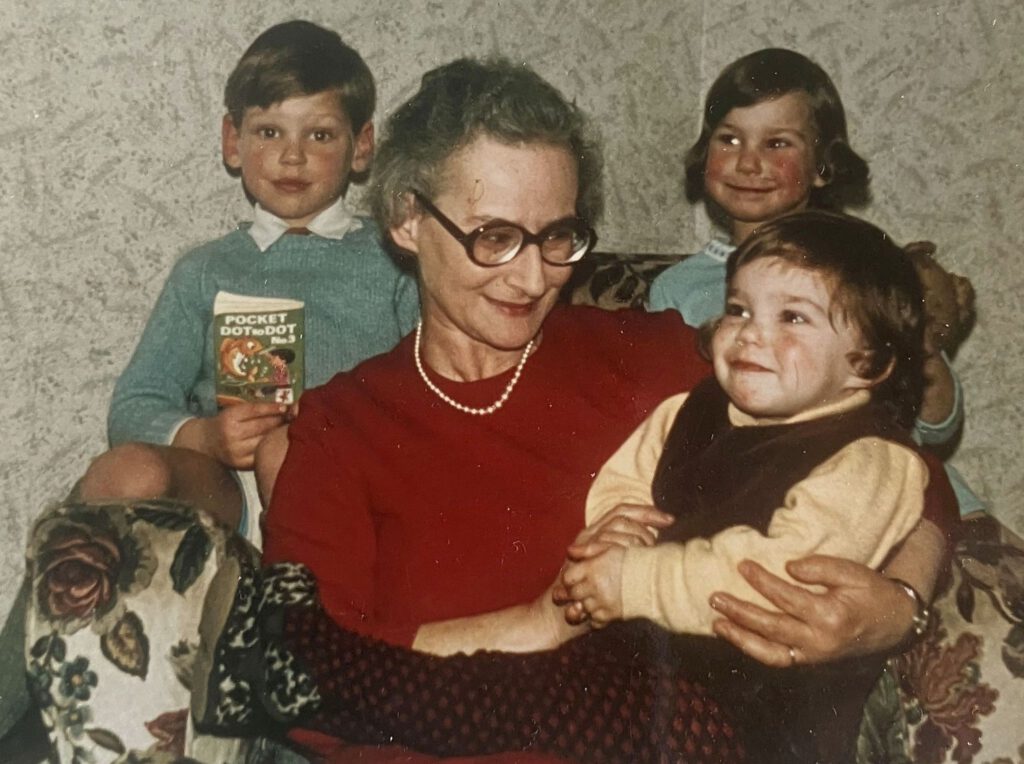
Judith Horsley with her
granddaughters and grandsons
(Source: Initiative Stolpersteine Göppingen)
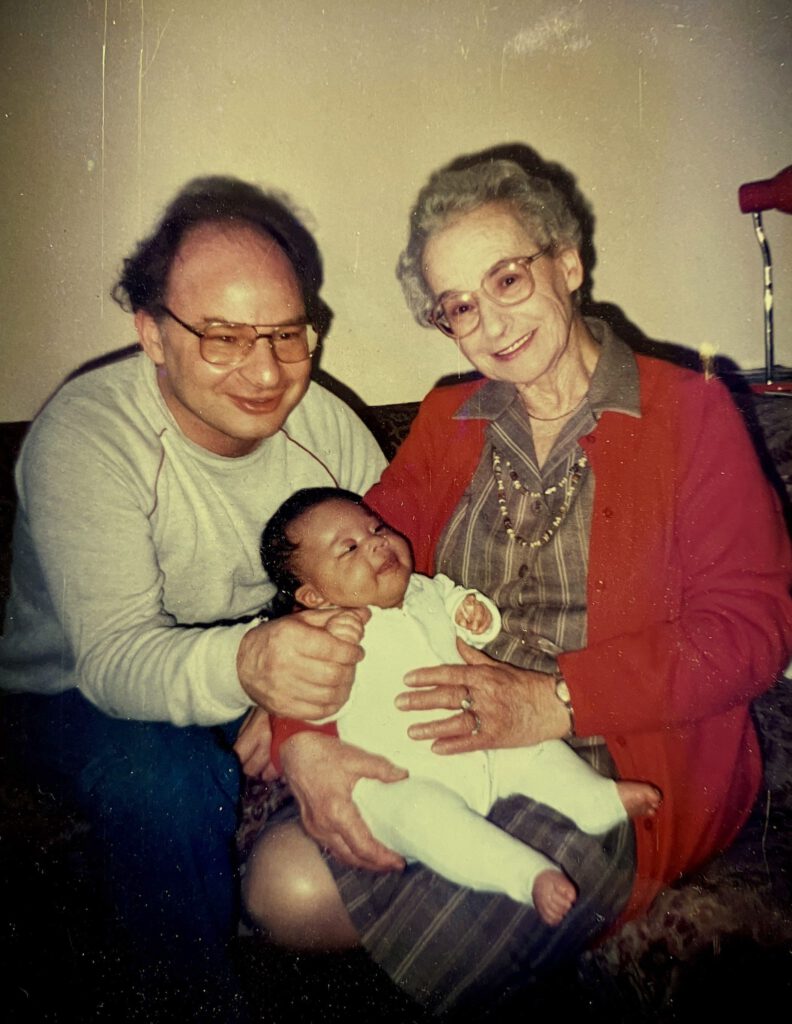
and granddaughter Ruth in 1988
(Source: Initiative Stolpersteine Göppingen)
It was not until 1967 that probate proceedings took place, in which the estate of Milda Salinger’s mother, Flora Rosenthal, was distributed among her living descendants, including Judith Horsley. There were no further restitution proceedings within the family.
Milda Salinger had, after all, never been able to personally accept her mother’s inheritance. Milda herself left behind a legacy of a special kind, as her grandson David Horsley put it:
Poem for Milda (Dedicated to Judy, my mother)
Milda is my hero
I never met her
My mother’s mother
She lived a good life
Until the gangsters took power
I know she enjoyed herself
I see it in the photographs
Then she was persecuted
She made sure her daughter was safe
Sent her to a new life in England
But Milda stayed
Caring for her husband and mother
He died of a heart attack
She of old age
Milda carried on alone
Living on tiny rations
Then they came for her
Squeezed into a cattle truck on a train
Did she know her destination
I don’t know
Straight to the gas chamber she was sent
Auschwitz her final home
Milda is my hero
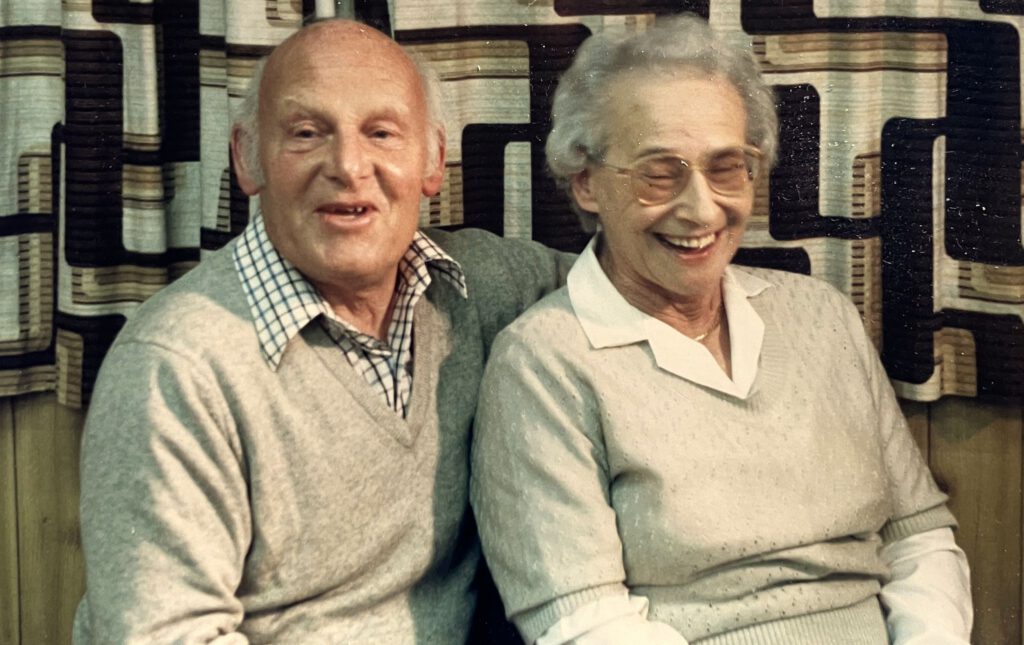
Judith Horsley, née Elfriede Salinger, visited her hometown of Göppingen in the 1980s and also met with her childhood friend Lilo Bailer, née Tausch. She died in England in April 1996 at the age of 78; her husband, James, passed away four years later.
(Source: Initiative Stolpersteine Göppingen)
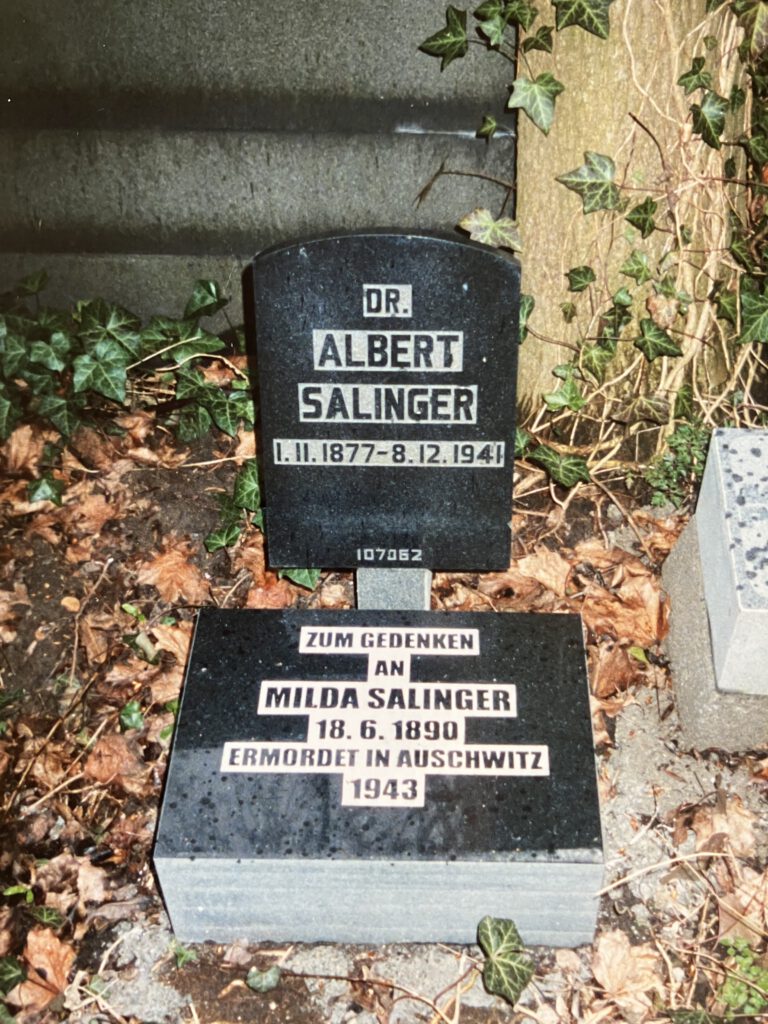
After his parents’ death in 2003, David Horsley set out on a trip to Berlin to find the grave of his grandfather, Albert Salinger. He knew from stories his mother had told him that Albert Salinger had been given a proper grave as early as 1941, and he had promised her he would look for it. David Horsley has vividly described his successful mission.
Not only did he find his grandfather’s grave (as well as those of his great-grandparents, Flora and Hermann Rosenthal), but he also added another headstone to Albert Salinger’s grave commemorating Albert’s murdered wife, Milda.
(Source: Initiative Stolpersteine Göppingen)
In 2004, David Horsley also visited Göppingen, where his mother had been born. There, he was able to convince Dr. Rueß, then director of the city archives, that Albert Salinger had died of natural causes – a fact also corroborated by photographs of the grave in Berlin. The background to this was that Albert Salinger had been erroneously listed in all major victim databases as having been “deported to the East.”
In 2025, David Horsley contacted the Stolpersteine Göppingen initiative, thereby initiating the project to install Stolpersteine for the Salinger family. We extend our heartfelt thanks to Mr. Horsley for the wealth of information, family memories, and photographs he has shared.
The Stolpersteine for Milda, Albert, and Elfriede Salinger are expected to be installed in January 2027 in front of the house at Poststr. 25.
(26.10.2026 kmr/ww)

