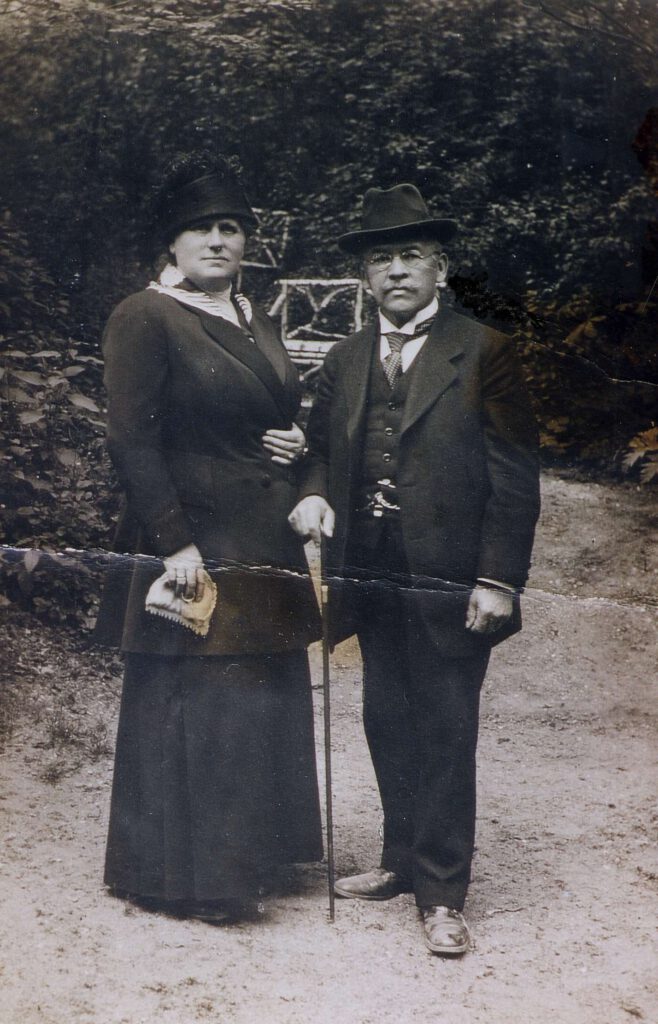
Born on February 5, 1879, in Göppingen
Murdered on September 17, 1942, in Buchenwald concentration camp
Stumbling stone in Stuttgart, Schlossstraße 83 / Fall 2026
Samuel Fleischer – a father figure?
When Samuel Fleischer moved from Mühlbach/Baden to Göppingen at a young age, where his mother’s relatives lived, he probably had ambitious plans. Several male members of his mother’s Rosenthal family had managed to establish themselves as entrepreneurs in the fashionable corset market and win industry awards for their products. Samuel’s uncle Daniel Rosenthal was even considered a a “pioneer of the corset industry.” Samuel joined his uncle’s company and became a partner in 1873. In 1878, he married his cousin Emilie Rosenthal. Emilie’s family were among the first Jewish immigrants to settle in Jebenhausen near Göppingen after 1777.
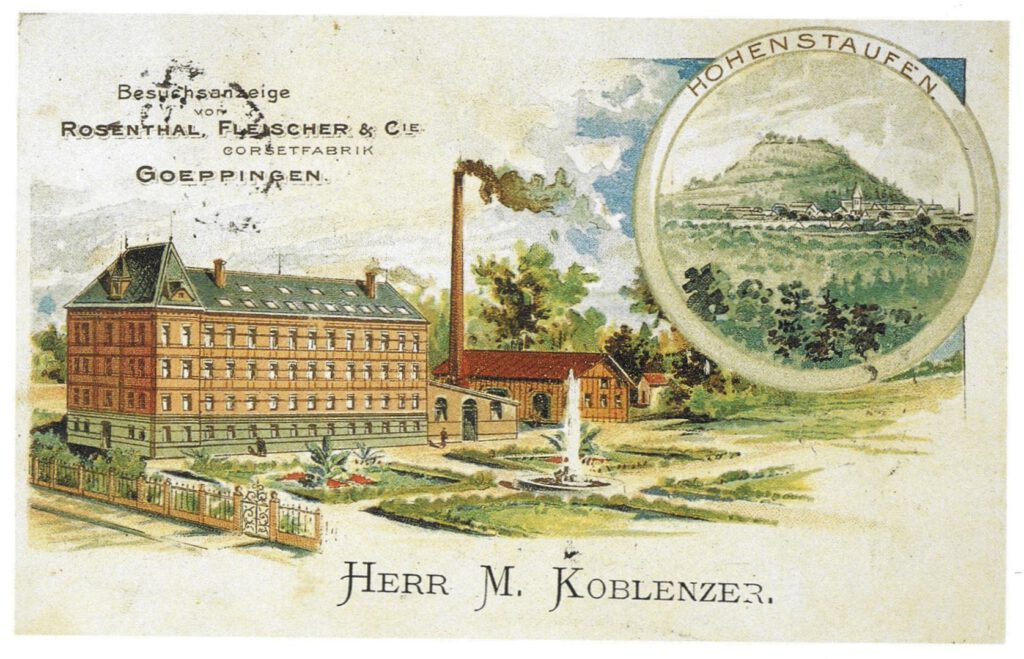
In 1887, Samuel founded his own corset factory with his brothers Leopold and Julius and his brother-in-law Adolph Rosenthal. Their new production facilities, built between 1894 and 1901, attracted attention: located in the ‘green’ area on the northern edge of Göppingen, they were surrounded by gardens that could be used by workers and employees.
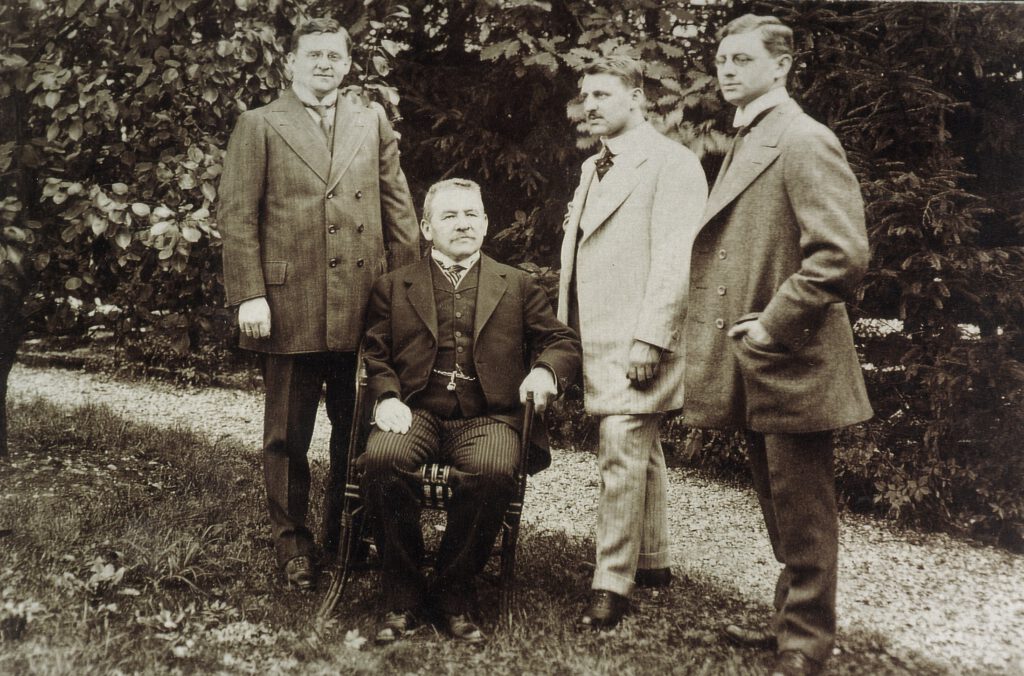
Samuel Fleischer was not only active as an entrepreneur: he was a member of the board of the Göppingen Jewish community for 35 years, co-founded the initially mixed-religion association ‘Merkuria’, and held a seat on the Göppingen municipal council from 1910 to 1919.
Bernhard – the firstborn
Bernhard Fleischer was born on February 5, 1879, the first child of Emilie and Samuel, and it would have been natural for the young parents to see him as the ‘heir’ to the business. A year later, their daughter Paula was born, followed two years later by their son Julius and, some time later in 1888, their son Arthur, who was to remain the couple’s last child.
When Bernhard was born, the family was still living in rented accommodation on Ziegelstraße in Göppingen with the cattle dealer Marx; the family’s prestigious house at 33 Nördliche Ringstraße was not built until around 1894.
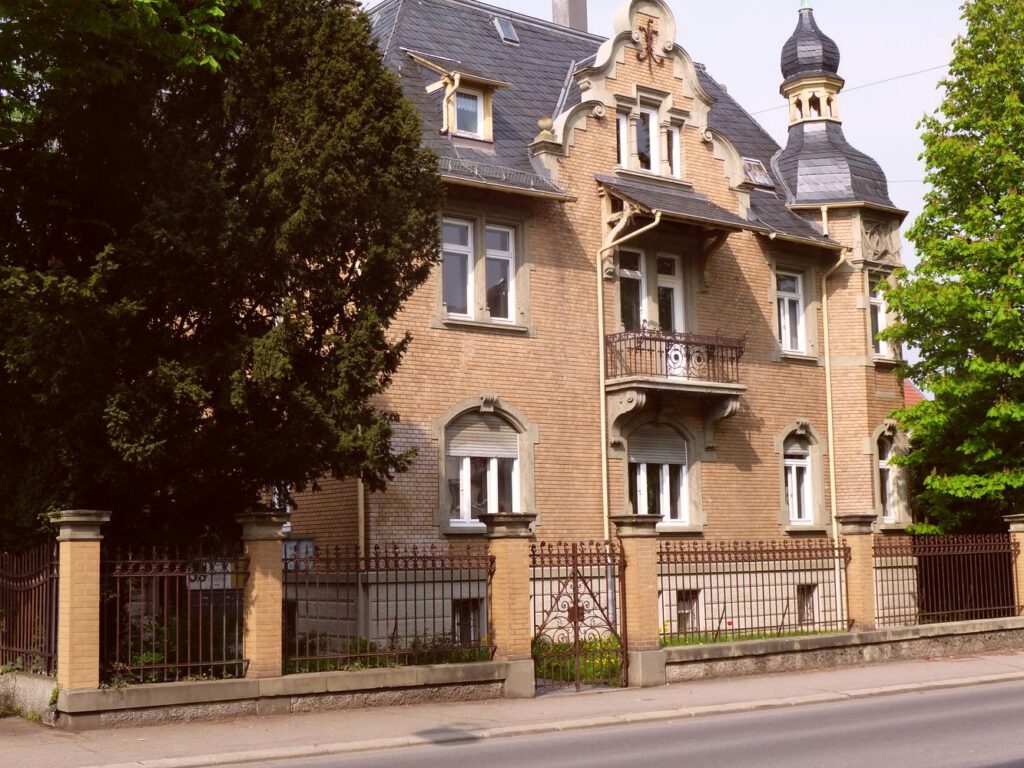
Nothing is known about Bernhard’s childhood. His mother Emilie is described in the memories of her granddaughter Doris Fleischer as a principled and rather aloof person; Bernhard was probably raised by a nanny. Bernhard experienced his confirmation, or bar mitzvah, under the care of Max Herz, the first modern rabbi in Göppingen. Later in life, Bernhard Fleischer probably identified little with his religious background.
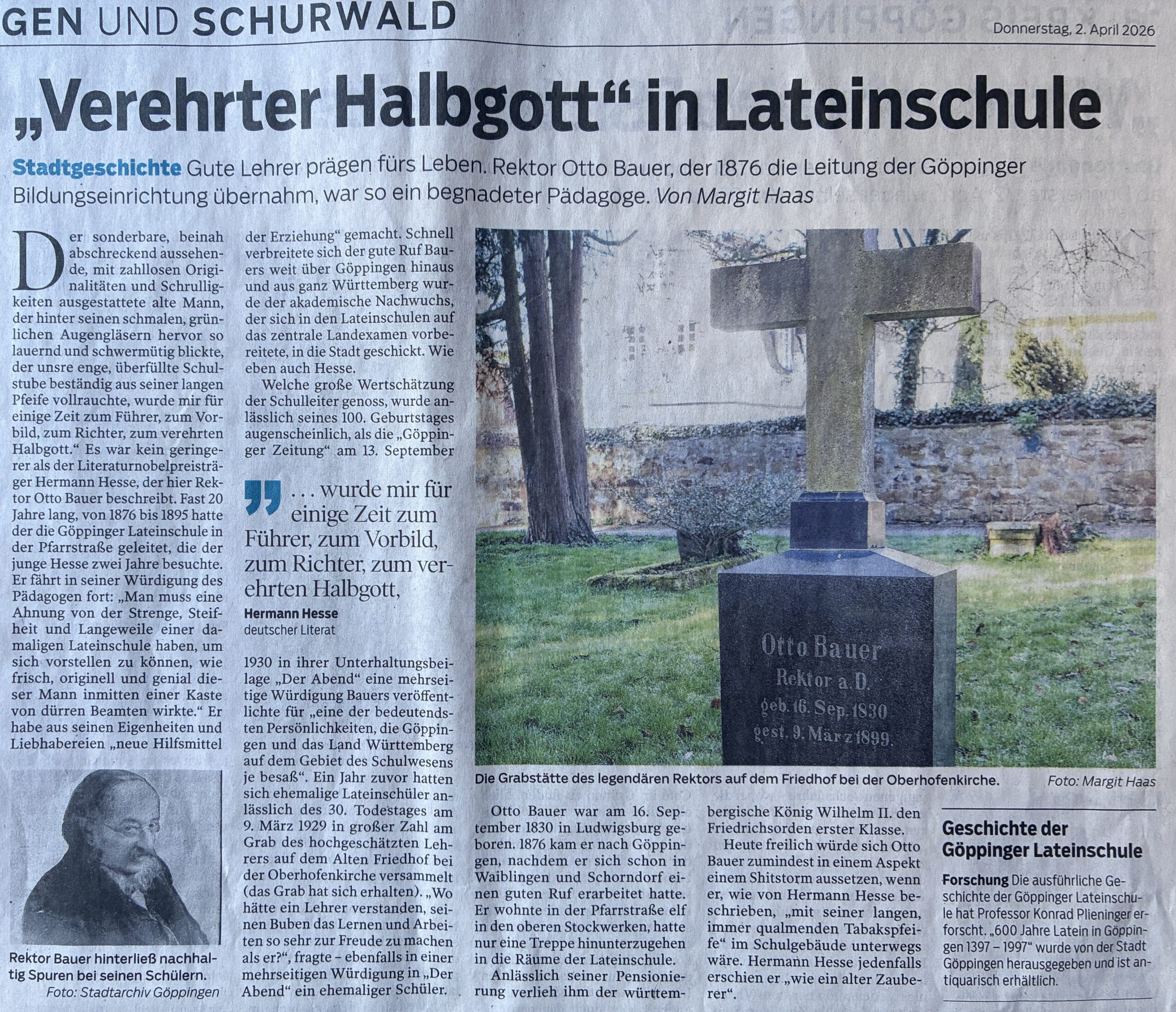
Bernhard Fleischer’s school education was unusual. After elementary school, he most likely attended the well-known Göppingen Latin School from 1889 onwards, which had originally been established primarily for future Protestant ministerial candidates and was then headed by the qualified principal Otto Bauer (Source link: NWZ, April 2, 2026).
One of Bernhard’s classmates at the Latin school (two years his senior) until 1891 was Hermann Hesse, who later became a writer and winner of the Nobel Prize for Literature. However, sons from the up-and-coming industrial bourgeoisie, who were expected by their parents to join the family business, were sent to the still young, six-form Göppingen secondary school. Bernhard’s parents therefore probably had a different path in life in mind for their first-born son than joining the family business. Bernhard Fleischer was probably the first Jewish student to graduate from high school in Göppingen and perhaps the only Jewish student at the Latin School in Göppingen during his school days. He was certainly the only one of his siblings who was allowed to obtain a university degree. His brothers Julius and Arthur, on the other hand, joined the family business and took over its management after the death of their father Samuel Fleischer in 1920.
Career choice – a self-chosen path?
With a high school diploma from a humanities school, Bernhard Fleischer, as a Jew, actually had only two study options: medicine or law. Bernhard decided to study law; whether this was on the advice of his parents remains unclear.
At that time, there was only one practicing lawyer in the Jewish community of Göppingen, namely Dr. Max Steiner, who, however, was not from Göppingen. Bernhard Fleischer was thus the first person from Jewish Göppingen to turn to law. He was later followed on this career path by Ludwig Ottenheimer, Benno Ostertag, Albert Steiner, and Paul Tänzer, all from Göppingen, who, with the exception of Albert Steiner, would later move to Stuttgart like Bernhard Fleischer.
Bernhard Fleischer must have graduated from high school in 1898 at the latest, because he began studying law at Ludwig Maximilian University in Munich in the winter semester of 1898. In the summer semester of 1900, he enrolled at Eberhard Karls University in Tübingen University in Tübingen, where he completed his studies in the summer semester of 1902. His time in Tübingen was interrupted in the winter semester of 1900 when he attended the Royal Friedrich Wilhelm University in Berlin. It is known from his Berlin interlude that, in addition to law lectures/seminars, he also had other interests: “Greek Literature since Nero – Prof. v. Wilamowitz-Möllendorff,” “German Playwrights in the 19th Century – Prof. E. Schmidt,” and “Italian Exercises – Lector Hecker” were the corresponding lectures/seminars. Bernhard Fleischer decided not to pursue a doctorate.
Stuttgart as his new home
After completing his studies, Bernhard Fleischer probably did his compulsory military service. Since he presumably only had to ‘serve’ for one year, the period until the next confirmed date in his life remains unclear: The 1906 Stuttgart supplementary address book contains the first entry: Fleischer, Bernhard, lawyer, Taubenheimstr. 26 P, Cannstatt. His workplace was also in Cannstatt: Bernhard Fleischer joined Martin Rothschild’s established law firm in 1907.
The joint law firm “Rothschild und Fleischer” in Cannstatt focused on civil law and existed until 1916. When Bernhard Fleischer went into business for himself, however, the majority of the client base remained loyal to his former colleague Rothschild. Bernhard Fleischer apparently did not have to participate in World War I.
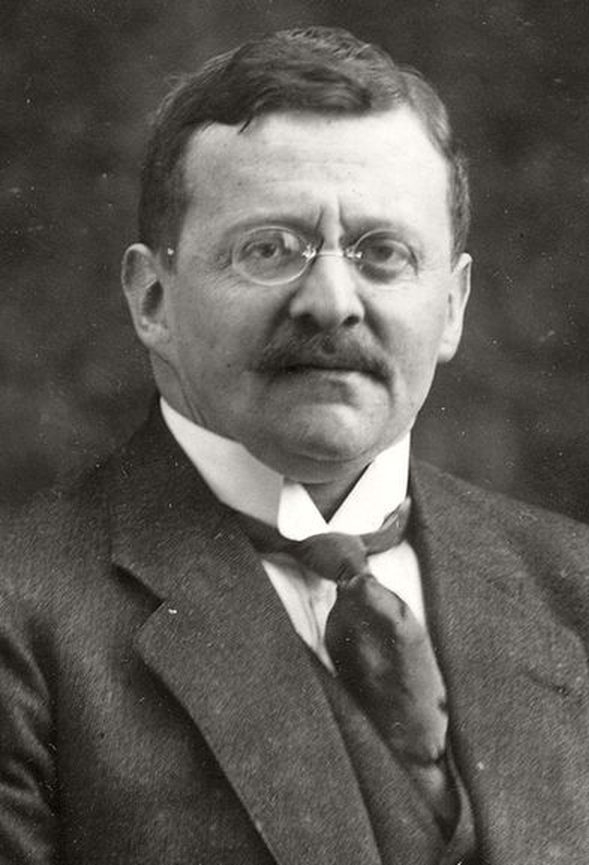
(Source: Ludwigsburg State Archives)
Emma Bikard from Rottweil
In the Fleischer family in Göppingen, it was still customary in Bernhard’s generation for marriages to be arranged. One exception was Bernhard’s brother Julius, who entered into a “love marriage,” which was not approved by their mother Emilie Fleischer despite the bride’s large dowry. Against this background, the question arises as to how and where Bernhard Fleischer met Emma Sofie Bikard, who was to become his wife on September 15, 1910.
Emma, born in 1889, came from a Jewish family that had originally lived in Rottweil.
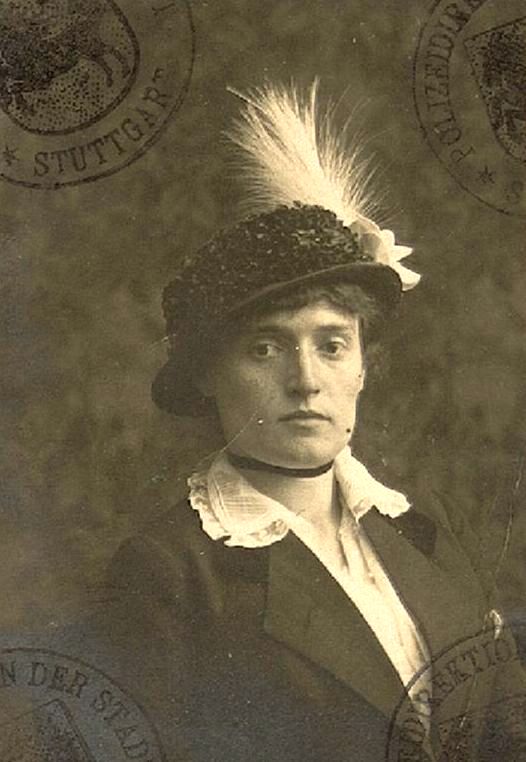
(Source: Ludwigsburg State Archives)
Her grandfather Max Bikard had acquired the “Brauerei zum Pfauen” brewery there and run it successfully. Around 1900, after selling the brewery, the family had moved to Stuttgart, where Emma’s father, Adolf Bikard, later ran a mortgage and loan brokerage on Königstraße. Adolf Bikard was also an active member of the National Liberal Party, sat on the supervisory boards of several companies, and served as an honorary lay judge.
Emma was the only (surviving) child of Klara, née Wolf, and Adolf Bikard, and certainly grew up in prosperity. It is not known whether she completed her education. At least from Bernhard’s perspective, his marriage to this intelligent, pretty, younger woman should have been a happy one. Did he know at the time of the marriage that Emma was already in love with another man? Allegedly, her parents persuaded her to marry Bernhard Fleischer anyway. Emma brought a considerable dowry into the marriage, which, according to his second wife Agathe, Bernhard made available (later?) to his brothers in order to stabilize the family business in Göppingen. With the upheaval in women’s fashion, corsets were hardly sellable anymore and the reorientation of the company was difficult.
Anneliese Sophie Fleischer – the daughter of Emma and Bernhard
was born in June 1911. At that time, the young family lived at Relenbergstr. 70, later at Hölderlinplatz 18. Even their child could not stabilize the marriage, and in August 1919, the couple divorced. At that time, the “fault principle” applied, and the marriage was divorced to Bernhard’s disadvantage. Emma and Anneliese then moved into Emma’s parents’ house. (More on Emma’s personal reorientation below …)
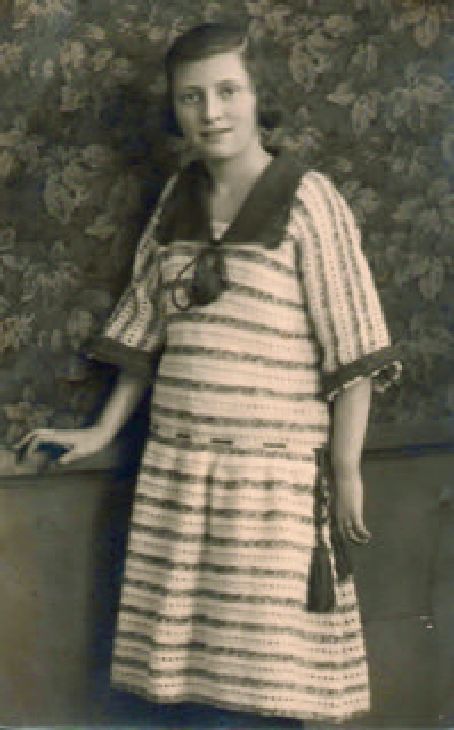
Anneliese first attended the Rothersche Mädchenschule (Rothersche Girls’ School) on Herdweg, then the Charlottenrealschule (Charlotten Real School). Regarding her vocational training, she writes in a restitution file:
“With the aim of becoming a chemical technician, I then attended the chemical testing laboratory and Dr. Karl Binder’s chemistry school. I took an exam at Dr. Binder’s in the spring of 1931. From April 7, 1931, to September 30, 1931, I did an internship at the Chemical Testing Office of the City of Stuttgart. Due to the poor economic situation at the time, I was unable to find a suitable job. So I was forced to work for my grandfather Adolf Bikard (…) as a stenographer. My grandfather paid me pocket money and provided me with free board and lodging. (…) Despite my best efforts, I was unable to find a position that matched my training and was also unable to complete my training as a chemical technician, so I was forced to train for a second profession. In February 1933, I traveled to Paris for this purpose. There I attended the Institut de Beauté Kéva. On October 10, 1933, I was awarded a diploma in pedicure. (…) After completing my training as a pedicurist, I worked at the Colman Institute for Cosmetic Surgery in Boulogne sur Seine. I received only a small salary for this work, as I was unable to obtain a work permit in France as a foreigner and was therefore forced to work “under the table.” (…) At the end of 1934, I returned to Stuttgart to my grandfather so that I could better organize my emigration to Palestine from there. On December 11, 1934, I married Mr. Herbert Levisohn in Stuttgart.”
In January 1935, Anneliese and Herbert Levisohn, who had met in Paris, fled via Marseille to Haifa.
Emma’s reorientation
Emma Fleischer was later confident enough to marry her lover, the Protestant Christian Wilhelm Schrag, whom she had initially given up on. Claudia Lorenz, Wilhelm Schrag’s biographer, describes the situation:
“In March 1919, Wilhelm Schrag is discharged from military service. He returns to Stuttgart and initially stays with his parents. Not long after, probably in the same year, he and Emma meet again. Emma caused a minor scandal in her social circle by divorcing her first husband. (…). In 1920, Schrag passed his second state examination as a government architect and married the woman he loved. The Bikard parents apparently quickly forgave the couple for taking their lives into their own hands. In the years that followed, they developed an excellent relationship with their new son-in-law.”
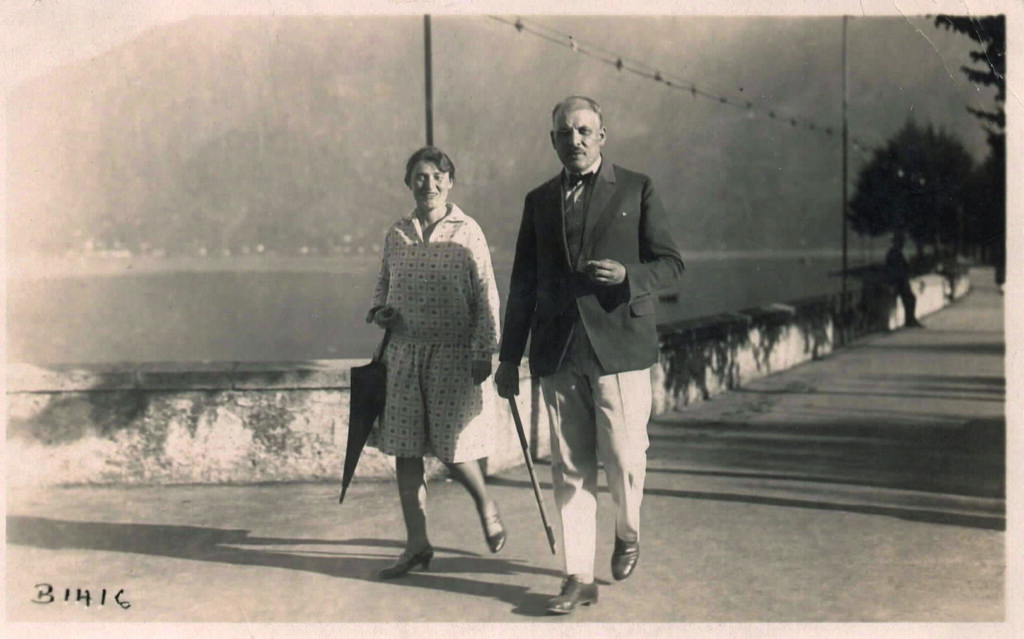
It should also be noted that Wilhelm Schrag was a liberal democrat and member of a Masonic lodge. Unfortunately, the love affair between Emma and Wilhelm Schrag came to a sad end: Emma Schrag died on August 15, 1928, three days after the birth of their daughter Ursula. Competent and politically ‘unburdened’, Wilhelm Schrag was appointed chairman of Stuttgarter Straßenbahnen AG (SSB) from 1946 until his untimely death in 1949.
Bernhard’s second marriage to Agathe, née Hiller, and daughter Beate Elfriede
About three years after his divorce from Emma, Bernhard Fleischer remarried: on December 27, 1923, he married Agathe Theresia Fleischer, née Hiller, a Catholic from Stuttgart-Vaihingen, who was 34 years old at the time.
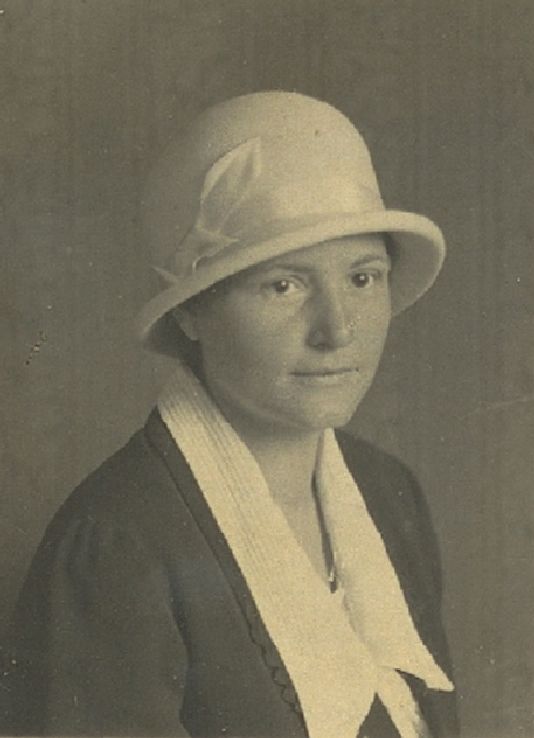
(Source: Ludwigsburg State Archives)
Like Bernhard, Agathe was also divorced; her first marriage was to a Johann Fleischer (sic!); she brought her seven-year-old son Siegfried into the new relationship. Agathe’s parents’ home was more middle class; her father Carl Hiller was a dyer by profession, and Agathe does not appear to have received any vocational training. The two witnesses to the marriage, Dr. Adolf Wider, a physician, and Dr. Otto Einstein, a pediatrician, were probably chosen by Bernhard Fleischer and give an indication of his circle of friends.
On January 24, 1925, Bernhard Fleischer became a father for the second time when his daughter Beate Elfriede Fleischer was born. The fact that she was baptized in her mother’s Catholic faith was apparently not a problem for Bernhard. In a restitution file, Agathe Fleischer provides the following information:
“We respected each other’s religious beliefs, and beyond that, I hadn’t really realized that I was married to a Jew. My ex-husband didn’t tell me about the personal humiliations and persecution he suffered because of his Jewish ancestry – at least out of consideration for me – until we got divorced.”
How close did Bernhard Fleischer remain to his family in Göppingen during his second marriage? Looking back, Agathe says that she “had a very good relationship with my divorced husband’s relatives and was respected by his mother”. Not all of his relatives in Göppingen had such harmonious memories.
The funny uncle from Stuttgart
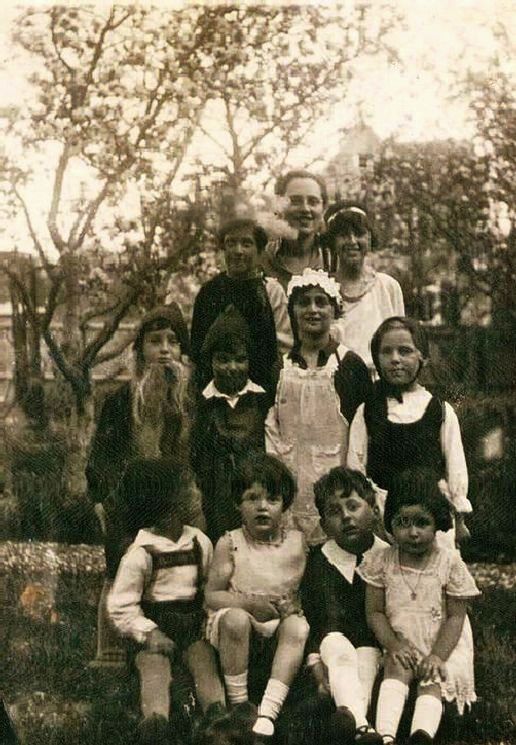
Sylvia Hurst, née Doris Fleischer, was the daughter of Bernhard’s brother Julius, who was a proponent of lifestyle reform and ate a predominantly vegetarian diet. She describes the “appearance” of her uncle Bernhard and her cousin Beate, who was about the same age, in Göppingen in her book “Laugh or Cry” (here in German translation):
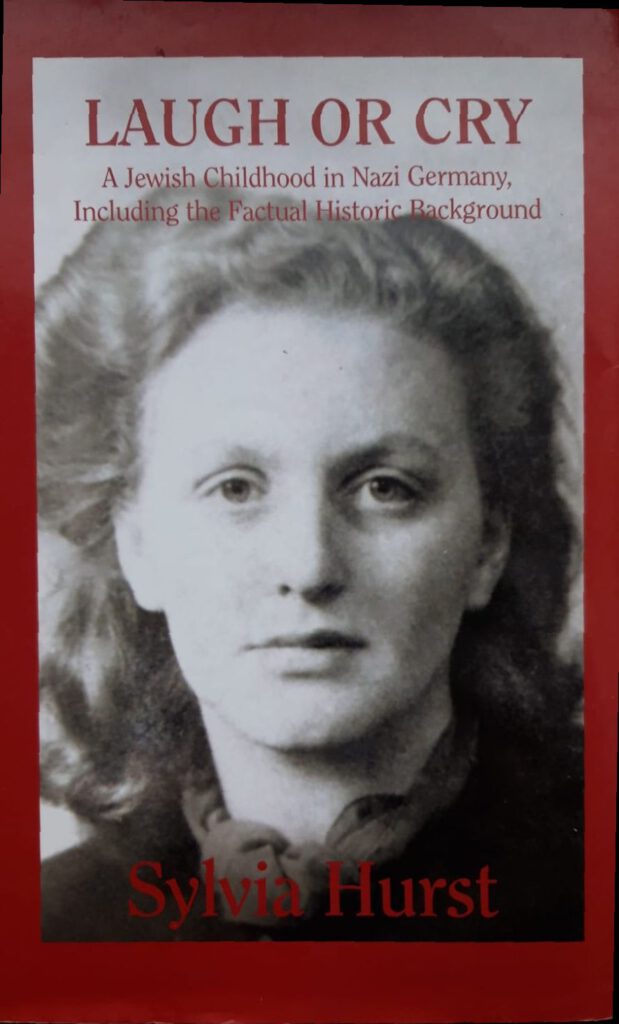
“Uncle Bernhard, my father’s older brother, was a lawyer. He used to speak to his daughter Beate only in improvised verse, at least in our presence, and Beate responded in the same way. They did this for quite a while. We ‘normal’ people were very envious of this gift. What’s more, we found fat Uncle Bernhard, with his tight Roman curls and tiny feet that made him wobble, absolutely horrible! He loved to tease us, especially by innocently inquiring about our mainly vegetarian diet. Did we eat anything other than grass? How did it taste? I interrupted him: ‘Maybe I can get Mother to invite him to dinner’ – he pretended not to hear me and continued, saying he couldn’t understand why more people didn’t try it, that it was very healthy for cows… and so on. Fortunately, he rarely visited us. If he had done so more often, he would have known that there was always meat for guests.”
Professional life: The fatal gravel pit and the ‘Blütenweiss’ steam laundry
Little is known about Bernhard Fleischer’s professional practice. After separating from his law partner Martin Rothschild in 1916, he did not enter into a new law partnership. The fact that he had his own office addresses from 1917 to 1935 (address book entries), meaning that his home and office were separate, could be taken as an indication of a ‘normal’ practice. From the 1936 to 1939 address books, he is listed with only one address as a ‘lawyer’, and thereafter as a ‘former lawyer’ or ‘private citizen’. The Nazis’ calls for a boycott of Jewish lawyers will certainly have cost him clients from 1933 onwards, combined with dwindling income. From 1935, after his divorce from Agathe (more on this later), both ex-spouses took their own new apartments; Bernhard’s new address was the same as his law office address: Kronprinzstr. 36, 1st floor. At this time, Bernhard Fleischer was already suffering from advanced blindness, which further hindered him in the practice of his profession and also made him helpless in everyday life.
Bernhard Fleischer must have already been in financial difficulties before the Nazi era: Agathe Fleischer states in a restitution file:
“He (Bernhard Fleischer – kmr) became the owner of a gravel plant in the Rhineland through a loan, but was defrauded in its management, lost a lawsuit and a large amount of his fortune. As he was financially affected by these events, I opened a laundry in around 1930. My husband’s Jewish ancestry was very helpful in this regard, as it made it easier to open the business due to Jewish customers.”
The laundry in question bore the beautiful name ‘Dampfwaschanstalt Blütenweiss’ (Blütenweiss Steam Laundry) and was entered in the commercial register on April 26, 1930, with Agathe Fleischer as the owner. The business was successful, with annual sales rising from 1,300 Reichsmarks in 1936 to 4,500 Reichsmarks in 1940, allowing Agathe to support herself and her two children after her separation from Bernhard.
Agathe may have initially run her laundry business from their shared apartment, as the business address Schlossstr. 69a first appears in the 1934 address book. According to the 1936 address book, Agathe, now divorced, lived next door to her laundry at Schlossstr. 69, initially still listed as “lawyer’s wife.” This title is omitted from the entries in subsequent years. It remains unclear how Beate, who was only ten years old and lived with her mother, coped with her parents’ separation. According to the divorce decree, her father was supposed to pay 300 RM per month in child support, but he was unable to do so regularly.
Bernhard Fleischer’s increasing blindness also contributed to his impoverishment. For this reason alone, he was apparently no longer able to practice his profession from 1936 onwards. The condition may have been hereditary, as his cousins Julie Goldstein and Rosa Fleischer, as well as his own mother, also went blind in old age.
The end of the second marriage / Grete Häussermann enters Bernhard’s life
As mentioned several times above, Bernhard Fleischer’s second marriage also failed, and it appears that his life went into a tailspin. One indication of this could be the frequent changes of residence between 1935 and 1942, which were probably not initially due to pressure from the Nazi administration. It is striking that none of his later addresses can be interpreted as a “Judenhaus” (Jewish house). The exception was the apartment at Eberhardstr. 1, where, incidentally, his Jewish lawyer colleague Benno Ostertag also lived in 1941, with whom Bernhard Fleischer had a lot in common, not least his origins in Göppingen.
The divorce, in which he was found ‘guilty’, became final on March 18, 1935. Agathe Fleischer gives her view in an affidavit from 1961:
“The deceased victim of persecution (Bernhard Fleischer – kmr) had been formally infatuated with a Mrs. Häussermann. She waited for him in the most distasteful manner and had meetings with him, which my then 15-year-old son from my first marriage observed. (From this age indication, it can be deduced that the year 1931 is meant.) This resulted in fierce disputes between this son and my divorced husband. I repeatedly tried to draw my divorced husband closer to me and remove him from the influence of Mrs. Häussermann. (…) I was extremely reluctant to separate from my husband and am still fond of him today, but the circumstances described forced me to divorce him.”
Agathe Fleischer further points out that she was divorced ‘without fault’ and that the divorce took place before the ‘Nuremberg Laws’ came into force – meaning that she did not leave her husband out of opportunism. Bernhard Fleischer apparently wanted to avert the divorce, but did not want to end his relationship with Grete Häussermann.
Grete ‘Gretchen’ Häussermann, née Ebbinghaus (1886 – 1967) had been married to bank clerk Julius Häussermann, who died in 1934. She had probably already met and fallen in love with Bernhard Fleischer during her husband’s lifetime, as she testified before a tribunal in 1948 that he had been their mutual legal advisor for many years.
In the clutches of the (Secret) State Police
With the transfer of power to the Nazis, relationships between Jewish and non-Jewish partners immediately fell into disrepute, and after the Nuremberg Laws came into force, they were criminalized. During his marriage to the non-Jewish Agathe, Bernhard Fleischer enjoyed the uncertain protection of a ‘privileged mixed marriage’, which the Nazi administration had formulated in December 1938 without, however, enshrining it in law. A ‘privileged Jew’ was someone who was married to an ‘Aryan’ under German law and whose children were raised ‘non-Jewish’. This status initially offered the Jewish spouse protection from deportation and did not oblige them to wear the ‘Jewish star’.
Often, divorced Jewish ex-partners also retained their previous status de facto, especially if they had children. Bernhard Fleischer was also arrested during the pogrom night of November 9-10. He was probably not sent to the Dachau concentration camp because he was only 59 years old – so the fact that he was divorced from his non-Jewish wife will not have played a role.
However, since the provisions of the ‘privileged mixed marriage’ were not laid down in law, local Jewish departments were able to make arbitrary decisions. In Stuttgart, it was criminal investigator Alfred Amthor who was called upon to act, because the (romantic?) relationship between the “Aryan” Grete Häussermann and the divorced “Jew” Bernhard Fleischer soon became public knowledge or was presumably denounced.
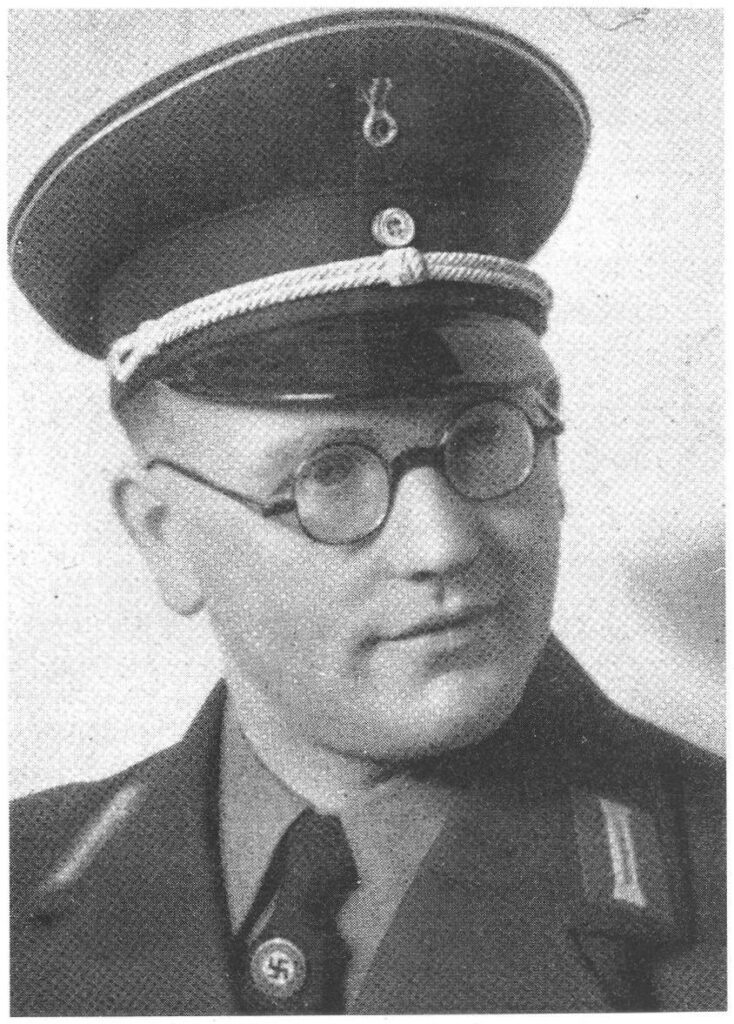
Alfred Amthor – a very ‘willing executor’
Amthor, born in Stuttgart in 1904, was a merchant by profession. After a long stay abroad, he returned to Stuttgart in 1936 and applied for a job as a driver in response to a coded job advertisement in 1939. The advertisement was placed by the State Police (Stapo). Alfred Amthor was offered a job there, not as a driver, but as a criminal investigator, which did not prevent him from accepting the position.
From 1941 onwards, his area of responsibility included two ‘Jewish affairs’. Roland Maier describes Amthor’s behavior in his book ‘Die Geheime Staatspolizei in Württemberg und Hohenzollern’ (The Secret State Police in Württemberg and Hohenzollern):
“Even if anti-Semitic convictions did not seem to be his defining motive, he was nevertheless considered one of the most unpopular and feared officials among Jews. A striking number of the cases he handled led to the individuals concerned being sent to concentration camps and subsequently to their deaths.“
Roland Maier attributes Amthor’s behavior to his position:
”This suggests that, as a newcomer to the police force and the party, he sought to compensate for his subordinate position as an employee without signing authority by acting in a ‘dashing’ manner.”
Stages leading up to the murder of Bernhard Fleischer
On May 18, 1942, Bernhard Fleischer, who was living at Schlosserstr. 24 at the time, was arrested in Stuttgart for “having a relationship with an Aryan woman” and was probably held in the police prison at Büchsenstr. 37. After about two weeks, on June 2, 1942, he was transported by train from Schorndorf to the Welzheim concentration camp/police prison along with ten other prisoners. It is not known whether there was a stopover at the Schorndorf prison on the way from Stuttgart. Roland Maier (see above) describes the conditions of detention in Welzheim: “The conditions were cramped; a cell measuring approximately two and a half meters wide and three meters long could hold up to six men.”
Bernhard Fleischer’s imprisonment in Welzheim lasted until the beginning of July 1942, when he was transferred to the Buchenwald concentration camp near Weimar on the 10th of that month. He was given prisoner number 848 and was classified as a ‘political prisoner’.
Bernhard Fleischer died on September 17, 1942, in the “prisoner infirmary” of the Buchenwald concentration camp. The official cause of death was “heart failure and old age.” The circumstances of his death are unknown to us; based on descriptions of life in the Buchenwald concentration camp, Bernhard Fleischer’s last months must have been horrific.
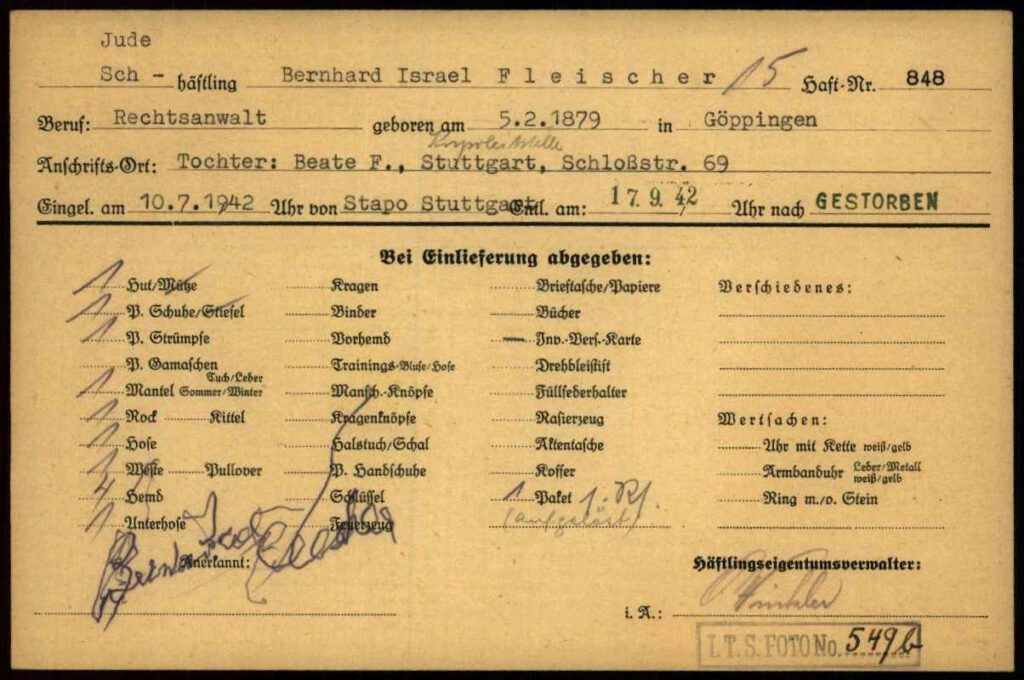
The expression ‘for love’ has been coined in relation to homosexual victims of National Socialism. It also applies to Bernhard Fleischer and Grete Häussermann. When restitution proceedings were initiated after the war, Bernhard’s daughters Anneliese and Beate were each entitled to half of the inheritance. However, apart from a few items of clothing, Bernhard Fleischer had left nothing behind, nor was there any property stolen by the Nazi state that could have been returned to the heirs.
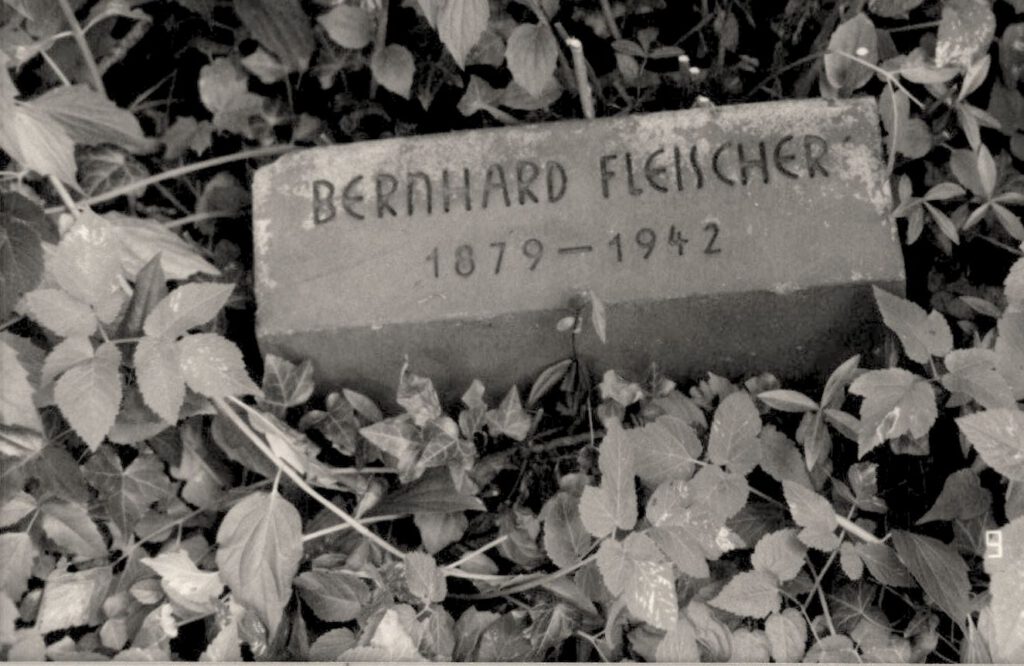
The urn containing his remains was delivered to his daughter Beate and was presumably buried by her in Stuttgart’s Pragfriedhof cemetery. This original grave was destroyed by aerial bombs. Today, an inscribed brick marks Bernhard Fleischer’s final resting place in place of the gravestone.
The denazification proceedings against Alfred Amthor
From 1946 onwards, Alfred Amthor had to answer to the denazification tribunal at the Ludwigsburg-Oßweil internment camp. Among other things, the ‘Häussermann/Fleischer case’ was also dealt with. As a witness for the prosecution, Grete Häussermann described her experiences with Alfred Amthor:
“On May 19, 1942, I was arrested for the first time by Mr. A. At the time, I was supporting a man of Jewish descent who was almost blind. As long as Mr. A. was in my apartment on official business, he behaved quite correctly and granted me certain concessions. But as soon as we were in his office, he behaved very arrogantly and insulted me with the most obscene expressions. Among other things, he said: ‘How can a German woman bring herself to help such filthy Jewish rabble? Jews are not human beings at all!”
After this interrogation, which took place at the ‘Hotel Silber’, Ms. Häussermann was placed in ‘protective custody’ for about 20 days ‘protective custody’ for about 20 days in the police prison in Büchsenstraße, from where she was then released without further questioning. She continues:
“On June 25, 1942, I was arrested for the second time by Mr. A. in connection with the same matter. On this occasion, however, he left me alone. On July 10, 1942, I was transported to Ravensbrück where I was held until October 9, 1942.“
Grete Häussermann also recalled Amthor’s behavior toward Bernhard Fleischer: ”Mr. Fleischer was also arrested by Amthor, and he made shameful remarks to the old man.”
Like almost all Nazi perpetrators, Alfred Amthor also used the defense of “state of emergency” in the “Fleischer case”:
“I could not destroy the report from the party, but had to process it. A request for protective custody had to be filed. It was not in my power to take the matter in a different direction.”
On May 23, 1949, the verdict of the Central Appeals Chamber of North Württemberg became final, and Alfred Amthor was classified as the ‘main culprit’. The judgment states that “Amthor acted for the Gestapo ‘in a manner incompatible with humanity.’” Amthor’s sentence included three years’ imprisonment in a labor camp. As a member of the Gestapo, Alfred Amthor was also involved in the deportation of thousands of Jews. In 1951, a trial was held before the Stuttgart Assize Court. In the further proceedings, Alfred Amthor and others were acquitted of the charge of ‘aiding and abetting aggravated deprivation of liberty in office, among other things,’ as the court also accepted the alleged ‘state of emergency.’
Murdered members of the Fleischer and Bikard families
Unfortunately, Bernhard was not the only victim of the Nazi dictatorship in the Fleischer family: his brothers Julius and Arthur, their wives, and his cousins Rosa Fleischer, Emilie Goldstein, and Martha Albert and her family were murdered in the Shoah, while his cousin Pauline Guggenheim fled to her death. (Links to the Göppingen Stolperstein entries and the ‘Albert’ text)
Bernhard’s mother, Emilie Fleischer, who had been unlawfully evicted from her apartment in Göppingen by the Nazi mayor of Göppingen, Dr. Erich Pack, died in April 1938 in the Jewish women’s dormitory on Dillmannstraße in Stuttgart.
The only one of his siblings to survive was Bernhard’s sister Paula Ries, née Fleischer
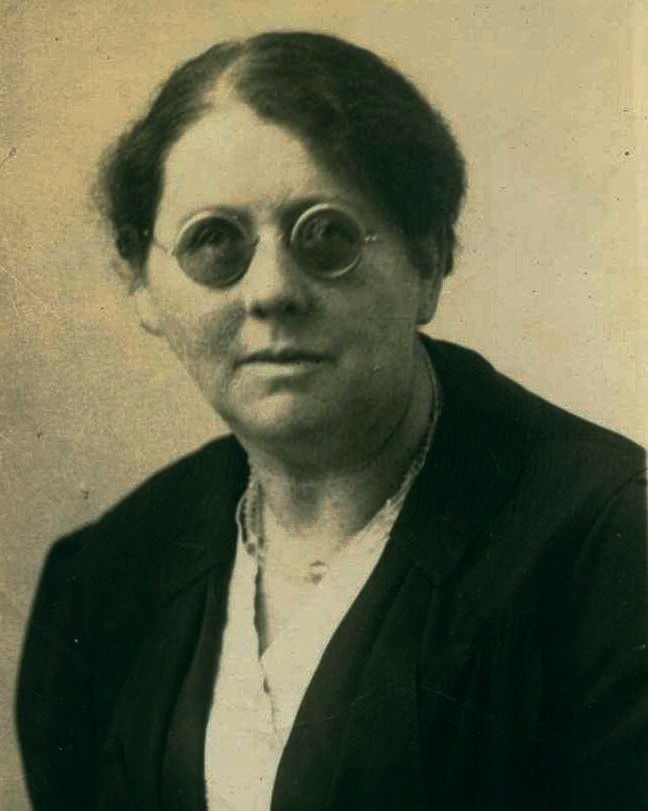
She was able to flee to England in 1939, where three of her children were already living.
From the Bikard family, Hedwig Baschwitz, née Bikard, lost her life in March 1943 in the Westerbork deportation camp in the occupied Netherlands. She was an aunt of Emma Fleischer/Schrag. The Baschwitz family had fled from Germany to Amsterdam in the Netherlands and fell back under Nazi control after the German Wehrmacht invaded in May 1940. Emma’s cousin Prof. Siegfried Kurt Baschwitz and his family survived in hiding and in the resistance.
Emma’s parents, Klara and Adolf Bikard, were able to flee to Switzerland in time, where they survived the Nazi era.
The further life of Agathe Fleischer and her three half-sisters Anneliese, Ursula, and Beate
Anneliese Levisohn, née Fleischer, and her husband opened a grocery store in Haifa, which they had to give up in 1942 because it was unprofitable. Anneliese then worked as a pedicurist and her husband as a laborer. This first marriage ended in 1951, and she found a new partner in Izhak Gruber.
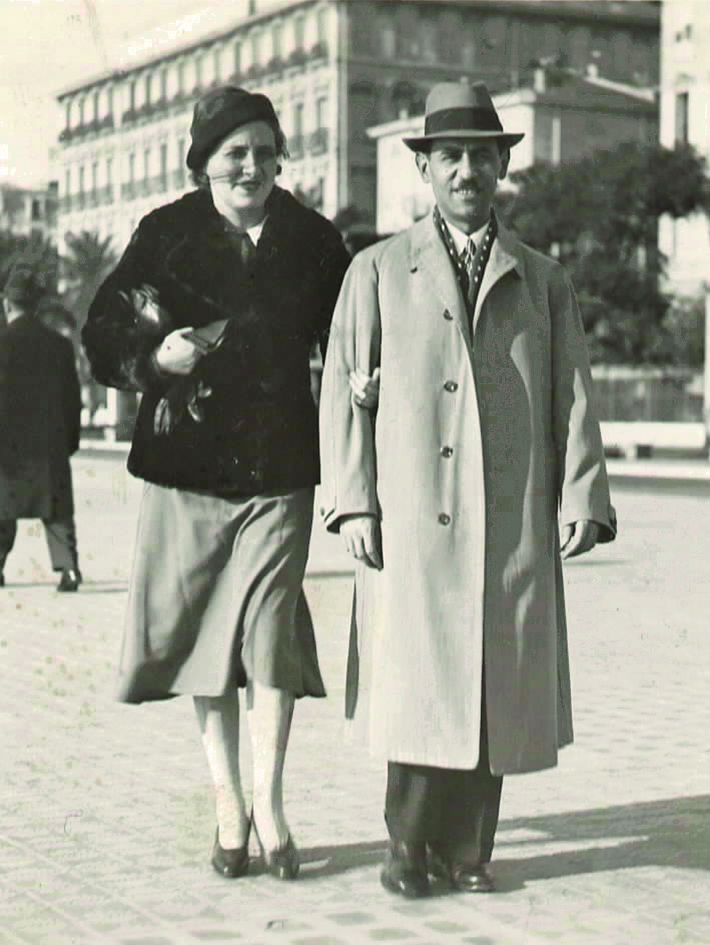
This partnership was also not blessed with material wealth; Izhak fell ill and could only work part-time. In 1956, they considered returning to Germany, but the plan was rejected. Anneliese Gruber, née Fleischer, died in 1994, widowed and childless, in Ramat Gan. She was in close contact with her half-sister Ursula Schrag and her cousins, who lived in Israel but originally came from Göppingen.
Anneliese’s maternal half-sister, Ursula Schrag, lived as a “half-Jew” during the Nazi era, despite the support of her paternal family, in a latently threatening situation. In 1943, she had to leave school and was forced to work at Zeiss Ikon in the arms industry. After the war, she caught up on the education she had been denied at the Waldorf School and began an apprenticeship in pottery after graduating. She later completed an apprenticeship as a dental technician and worked in this profession. In 1952, she married Heinz Ivers-Tiffée and had two children with him. Later, she worked as an executive secretary at a heart center. Ursula Ivers-Tiffée, née Schrag, died in 2015.
We know very little about Anneliese’s paternal half-sister, Beate Drobig, née Fleischer; she too would have been harassed and discriminated against as a “half-Jew” during the Nazi era. It was therefore only natural that she initially worked in her mother’s laundry.
After the war, Beate and Agathe Fleischer moved their business to Rutesheim, where it remained until mid-1961. In 1947, Beate married Karl Hermann Schechinger; the marriage ended after three years. In 1955, Agathe and Beate moved to Leonberg-Eltingen, and in the same year Beate married Hans Paul Drobig, who was 14 years her senior and came from Upper Silesia. Agathe Fleischer, who did not remarry, died on October 30, 1977, in Leonberg-Eltingen. Her daughter Beate Drobig, née Fleischer, also died in Leonberg in 2017. She had no descendants.
In the fall of 2026, a Stolperstein will be laid in Stuttgart, Schlosstr. 83, in memory of Bernhard Fleischer.
We owe our information about Emma Fleischer, née Bikard’s second marriage to Arthur Schrag to Claudia Lorenz’s book: “Lebens-Bahnen, Persönlichkeiten aus Stuttgarts Nahverkehr Band 4” (ISBN 978-3-9819803-3-2). We would also like to thank Ms. Bettina Ivers-Tiffée for further insights into the family history and for providing related photos. We found information about the role of Stapo employee Alfred Amthor in the persecution of Bernhard Fleischer and Grete Häussermann in: Ingrid Benz, Sigrid Brüggemann, Roland Maier (eds.) ‘Die Geheime Staatspolizei in Württemberg und Hohenzollern’ (The Secret State Police in Württemberg and Hohenzollern) (ISBN 3-978-89657-145-1).
(06.03.2026 kmr/pr/ww)